Your firm can hold the number one spot in the map pack and still watch the phone ring less than it did a year ago. That is the strange new reality of local search in 2026, and it is not a reason to panic. It is a reason to get serious about strategy.
For most of the last decade, local SEO for law firms followed a simple loop. Rank in the map pack, earn the calls, sign the cases. That loop still works. It just leaks more than it used to, and the leaks are hard to see in a normal ranking report.
Here is the part most firms miss. The answer is not to buy more of the same. The firms we see winning right now are not the ones with the most backlinks. They are the ones who started with a clear growth goal and built a strategy to hit it. Search is changing fast, and rankings no longer mean what they used to, but strategy is what separates the firms that grow through the change from the firms that quietly lose ground.
TL;DR: Key Takeaways
- Calls are dropping even when rankings hold. Profiles in top positions are seeing fewer calls year over year, and most rank trackers cannot see why.
- Losing some rankings is not the same as losing cases. We have seen firms drop a few positions and still win better leads, because they show up for the searches that actually convert.
- AI Local Packs are shrinking the map pack. They often show one or two firms instead of three, and many versions drop the call button entirely.
- Google’s own AI, not ChatGPT, is taking your blog traffic. And searchers are typing longer, more specific questions, which rewards firms that tell detailed, real stories.
- Strategy beats tactics. A generic vendor building backlinks and citations is not a plan. Start with your growth goals, then diversify within Google to match.
Your Google Business Profile calls are quietly disappearing
This is the trend that worries us most, because it hides so well. A firm can rank exactly where it did last year and still lose calls month after month.
Sterling Sky, a respected local SEO agency, partnered with the analytics company Jepto to study this. They looked at 179 Google Business Profiles across 34 law firms in the United States and tracked calls over two years. The pattern was clear. Calls from the business profile declined steadily, even for firms that never lost a ranking position. You can read the full breakdown in Sterling Sky’s State of Local SEO in 2026 report.
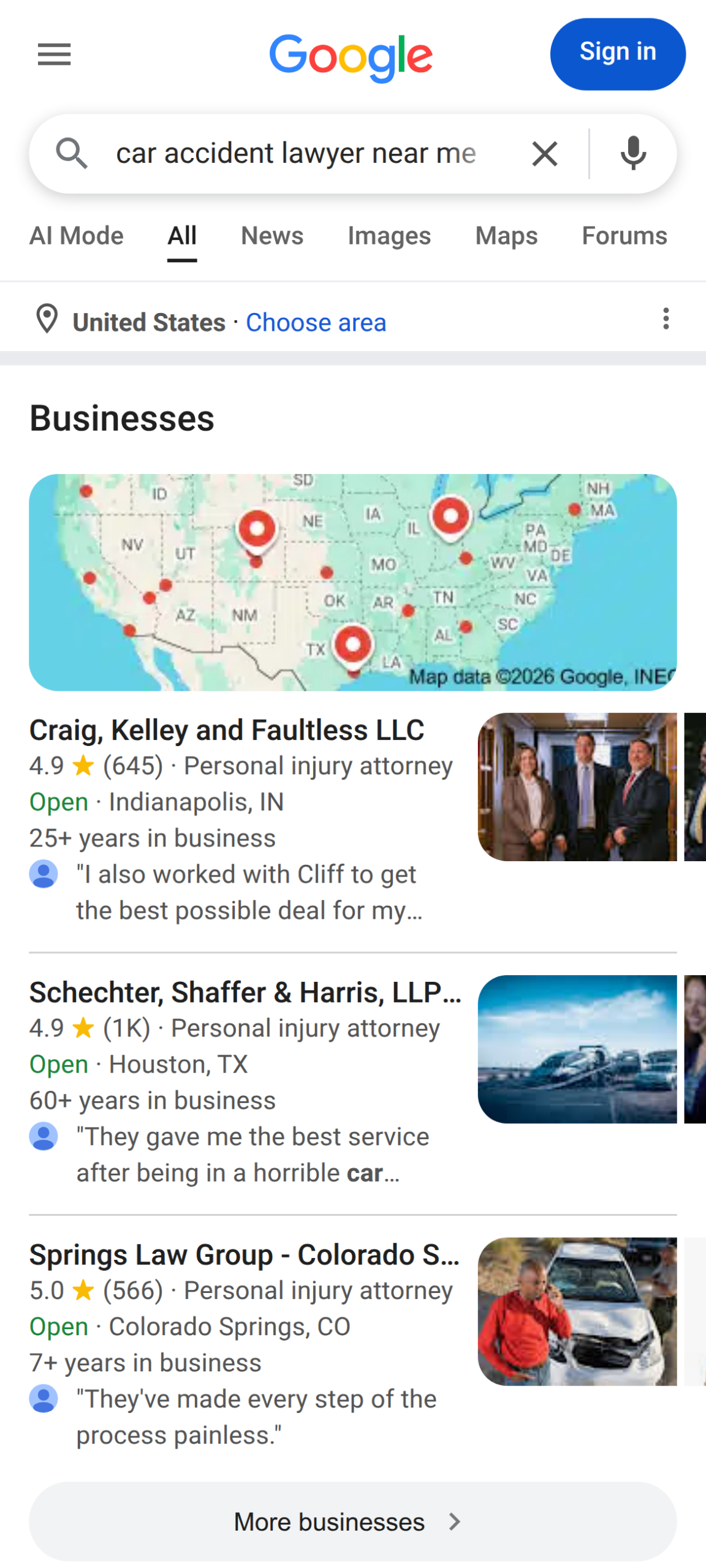
Two details matter for law firms. First, the decline was specific to mobile, where the phone icon and the click to call action live. Website clicks, which show up more on desktop, held steady. Second, your rank tracker probably shows everything as fine, because it cannot see what is replacing the old map pack. Sterling Sky calls this rank blindness, and it is exactly why so many firms feel a slowdown they cannot explain. We dug into this same pattern in our own breakdown of why your rankings can hold while your calls fall.
Losing rankings is not the same as losing cases
Here is where our perspective splits from the usual panic. Rankings are a means to an end. The end is signed cases. We have worked with firms that slipped a position or two on a few terms and still came out ahead, because the visibility they kept was the visibility that actually converts.
A number one ranking on a broad, generic phrase can send you a flood of tire kickers and cases you do not even want. Showing up at the right moment, for the right kind of search, with content that speaks to that exact situation, brings in fewer but better leads. We have seen clients lose a little ground on a vanity keyword and watch their quality of leads go up at the same time.
So before you chase every lost position, ask a better question. Are the leads you are getting the ones you want to sign? If the answer is yes, a ranking dip is not an emergency. It is a sign your strategy is pointing at the right targets.
AI Local Packs are shrinking the map pack
Google is rolling out an AI powered version of the local pack. Instead of the familiar three business results, this format uses AI to assemble a narrower answer. The data on it is rough for local businesses.
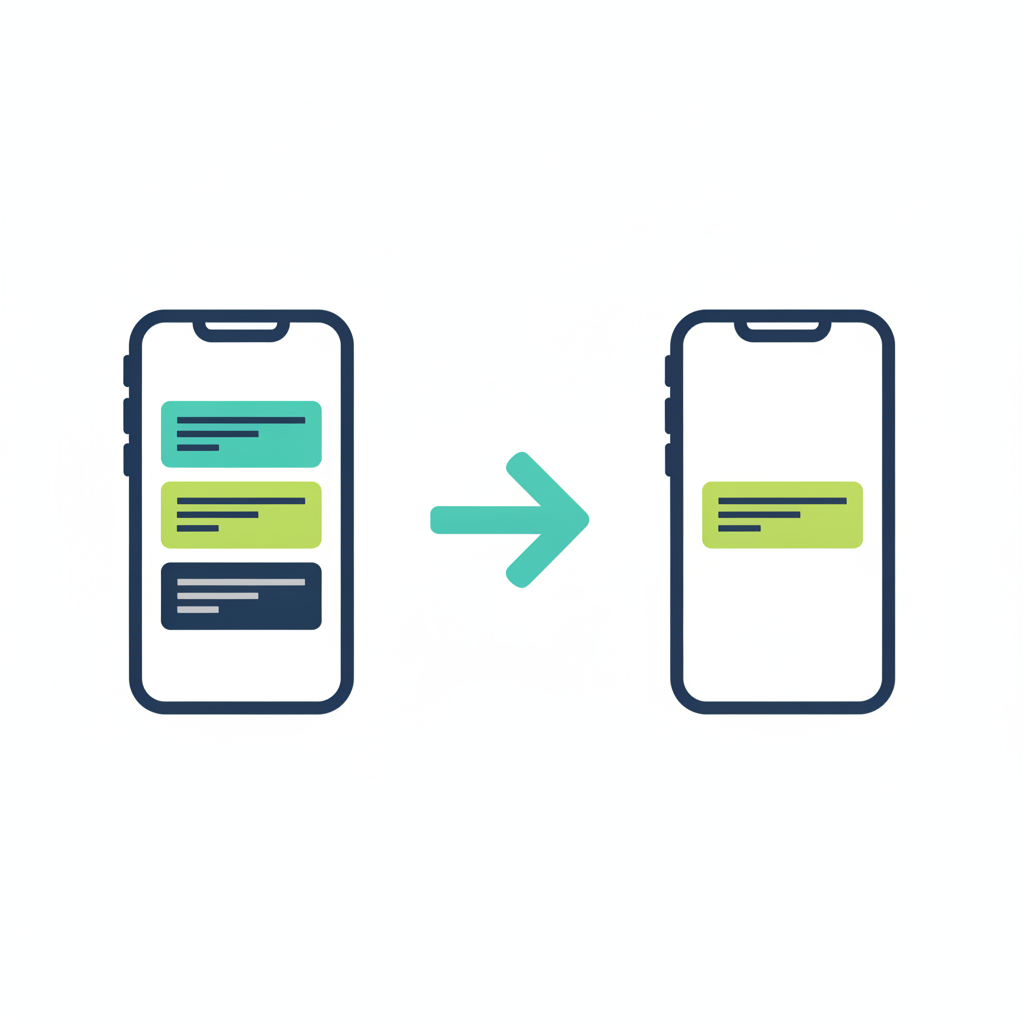
- These packs currently appear on roughly 7 to 8 percent of tracked mobile keywords in the United States, and that number is rising.
- They often feature only one or two firms instead of three.
- Many versions remove the call button completely.
- They frequently surface different businesses than the ones that held the traditional three result pack.
When Places Scout analyzed a large set of ranking reports, AI Local Packs surfaced 5,943 unique businesses where traditional local packs surfaced 18,330. That is about a third as many. Across 322 markets studied, 88 percent showed fewer unique businesses in the AI version than in the standard pack.
For a personal injury, criminal defense, or family law firm, this is a direct hit. Those are urgent searches, often on a phone, where the caller wants to tap and talk to someone right now. Fewer slots and fewer call buttons means fewer of those calls reach you, no matter how well you rank.
Related: How New Law Firms Can Compete in the Map Pack Without Spending $500 a Month
Google’s AI is eating your blog traffic, not ChatGPT
A lot of firm owners assume ChatGPT is stealing their website visitors. The data tells a different story.
Sterling Sky looked at one of its largest multi location clients and found that ChatGPT sent about 2 percent of the traffic Google did, up from roughly 0.1 percent the year before. Real growth, but still a small slice, and still only about a fifth of what Bing sends. The traffic is not vanishing into ChatGPT.
The bigger culprit is Google itself. AI Overviews now answer many informational questions right on the results page, so the visitor never clicks through. Seer Interactive has published data showing that when an AI Overview is present, clicks to websites fall. Our own click study on AI Overviews versus traditional organic found the same pull away from clicks. Firms that spent years publishing generic articles are feeling that drop.
The word that matters there is generic. The way people search has changed. Whether they are in Google or ChatGPT, they are typing longer, more detailed questions than they used to. That shift is bad news for thin, interchangeable content, and it is a real opening for firms willing to be specific.
Related: SEO vs. GEO: What Law Firms Must Know About AI Powered Search in 2026
Tell your specific story, because generic is losing
This is one of the strategies working best for our clients right now, and almost nobody is doing it well. Stop publishing the same general guides every firm publishes, and start telling your own real stories.
Think about the actual cases your firm has handled. A rear end collision on a specific highway at rush hour, the herniated disc the insurer tried to call a preexisting condition, the months of back and forth, the result you fought for. Written carefully and ethically, that level of detail is exactly what a real person is now searching for. They are not typing “car accident lawyer.” They are describing their situation in a full sentence, often to ChatGPT or Google, with details that sound a lot like a story.
The more specific you are, the better you match those longer searches, and the more likely an AI system is to pull your page into an answer. A detailed account of a real case, a particular injury, a specific court or county, a narrow question a client actually asked, all of it beats one more generic overview that reads like every competitor’s page. This matters even more in practice areas where criminal defense searches behave differently in AI than the usual research style queries.
This is not about volume. It is about being the firm that actually says something. Generic content is getting absorbed by AI and forgotten. Specific, human stories are getting found.
Related: How to Get Your Law Firm Cited in ChatGPT and Perplexity Searches
Paid is reclaiming the top of the page
Here is the part nobody wants to hear. Google is moving toward pay to play, and the numbers back it up.
At the start of 2025, local pack ads showed on about 1 percent of the mobile reports Sterling Sky tracked. By January 2026 that figure was almost 22 percent. Local Services Ads followed the same path, rising from roughly 11 percent of tracked queries to about 31 percent. It is one reason law firm marketing costs have climbed so sharply.
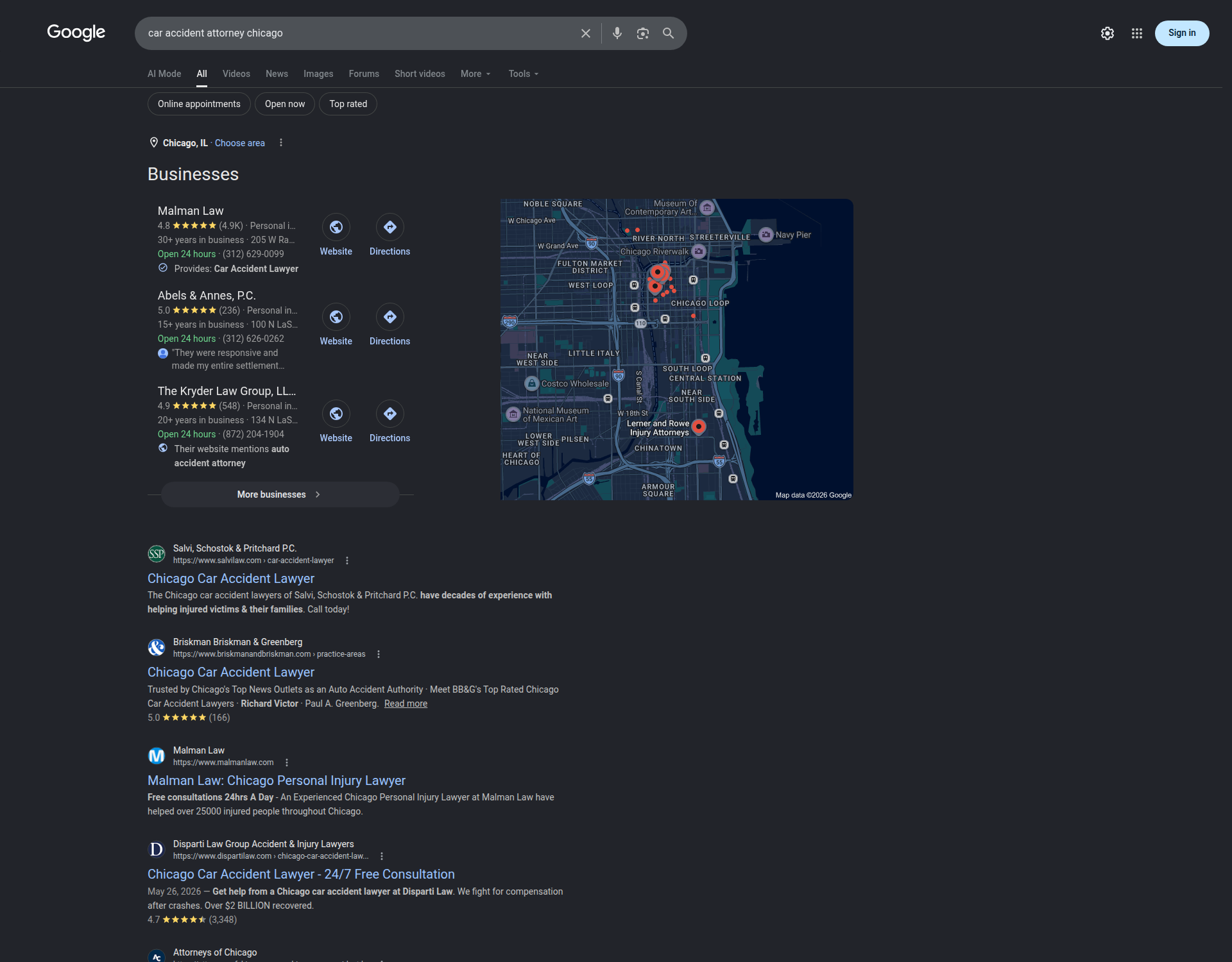
The silver lining is that ads now hold the placement and the features that organic listings are losing, including the call button. Firms running ads are reporting better return than before, simply because the ads sit where the calls used to come from for free. Local Services Ads in particular fit law firms well, since the Google Screened badge and the pay per lead model match how legal intake works.
None of this replaces strong organic local SEO. It is part of a bigger idea we keep coming back to. The firms holding their ground are diversifying within Google itself, claiming the map pack, the ad slots, Local Services Ads, and the AI answers all at once, instead of betting everything on a single organic ranking.
The December 2025 core update raised the bar
Core updates are not new, but this cycle is harsher, and small businesses are no longer safe from it. Sterling Sky reports auditing law firm and local sites that lost more than 90 percent of their organic traffic after the December 2025 core update, even while their map pack rankings stayed strong.
A recurring cause is links. Not the obvious paid links, but patterns of keyword rich anchor text, sometimes built years ago by a prior SEO vendor, sometimes appearing without the firm even knowing. When Google connects the dots, a site wide classifier can suppress an entire domain, and recovery usually waits for a future core update. This is the risk you take when a vendor sells you links and citations as the whole plan.
One practical tip from the Sterling Sky team. When you check your traffic in Google Search Console, remove your branded queries and the URL you link to from your Google Business Profile. Without those two filters, the brand and map traffic mask the real organic decline, and many firms never notice the drop until it is severe.
Local SEO myths that waste firm budgets
Sterling Sky runs controlled tests on local ranking factors, and several pieces of common advice did not survive. Worth knowing before you pay anyone to do these for you.
- Title tags must stay under 60 characters. That is a tool warning, not a Google rule. Longer titles can still rank well.
- A descriptor in your Google Business Profile name will get you suspended. It is possible but rare, and usually fixable by showing Google a matching DBA.
- Adding service areas improves where you rank. Testing shows no ranking effect. For firms with multiple offices and overlapping areas, it can actually trigger suspensions.
- Backlinks to your Google Business Profile boost rankings. Any lift is temporary. Build quality links to your website instead, where they help both the map pack and organic results.
An edge most firms miss: entity relationships
Google increasingly treats the world as a map of connected entities rather than a list of addresses, and that has a specific consequence for law firms with named attorneys.
Individual attorney listings connect to the firm through a relationship Google handles in the background, often called a Works At connection. When an attorney leaves and that link is never severed, the firm can lose ranking strength, or the attorney’s profile can keep showing the old firm’s address. When a new attorney joins, the connection needs to be established correctly. Auditing these relationships is unglamorous work that quietly protects your local authority.
Related: From Search to Signed Case Without a Website Visit: The New Client Journey
What your firm should do in 2026
The changes are real, but none of them require panic. They require a real strategy instead of a generic checklist. Here is where we would put the effort.
- Start with your growth goals, then build the strategy to match. Decide what kind of cases you want and how many, then know what your competitors are spending and reverse engineer the marketing from there. This is the step most firms skip, and it is the one that matters most.
- Measure quality, not just rankings. Track signed cases and lead quality, not only positions. A ranking dip with better leads is a win, not a loss.
- Tell your specific stories. Real case studies and detailed, situation specific content win the longer searches people now use in Google and AI tools.
- Diversify within Google. Claim the map pack, Local Services Ads, Search ads, and AI answers together, so one format losing ground does not sink your pipeline.
- Keep your Google Business Profile and reviews strong. Organic local visibility still matters, and AI systems still pull from firms that earn trust signals.
- Clean up your attorney listings. Fix Works At relationships when people join or leave so your authority does not leak.
Search is going through a turbulent stretch, and plenty of firms are getting hurt by it. The ones we see thriving are not lucky. They traded the generic backlink and citation routine for a strategy aimed at real growth goals, and they got more aggressive while everyone else froze.
Frequently asked questions
Is local SEO dead for law firms in 2026?
No. Organic local search still drives the majority of leads for most firms, and the vast majority of searches still happen on Google. It is changing, not disappearing. The firms that pair strong local SEO with paid coverage and specific, story driven content are the ones holding their ground.
Our rankings dropped. Should we panic or switch vendors?
Do not panic over the number alone. Look at lead quality and signed cases first. If those are healthy, a ranking dip may not matter. If they are sliding, the fix is usually a real strategy tied to your growth goals, not another package of backlinks and citations from a generic vendor.
Should we move our whole budget to ads?
No. Ads now hold placements that organic is losing, so they deserve a real share of the budget, but they work best on top of a healthy Google Business Profile and website. Treat them as part of diversifying within Google, not a swap.
Is ChatGPT taking our clients?
Not in any meaningful volume yet. The current traffic loss comes mostly from Google’s own AI Overviews and AI Local Packs. It is still smart to track AI traffic and to write the specific content these tools like to cite, because that could change quickly.
Why are our calls down if our rankings are the same?
Because the format around your ranking changed. AI Local Packs and image heavy results are removing call buttons on mobile, so the same position now produces fewer taps to call. Your rank report cannot see that shift.
Want a local search strategy built around your firm’s growth goals?
Let’s TalkLast updated: