
The visitor
An injured person or family member looking for a straight answer.
Turn your firm’s reputation into a website people trust.
We plan, write, design, build, and migrate law firm websites around the clients and cases you want more of. Launch a focused standalone site or rebuild a complex one. Ongoing marketing is optional.
Strategy, content, design, development, and launch protection—scoped around your firm.
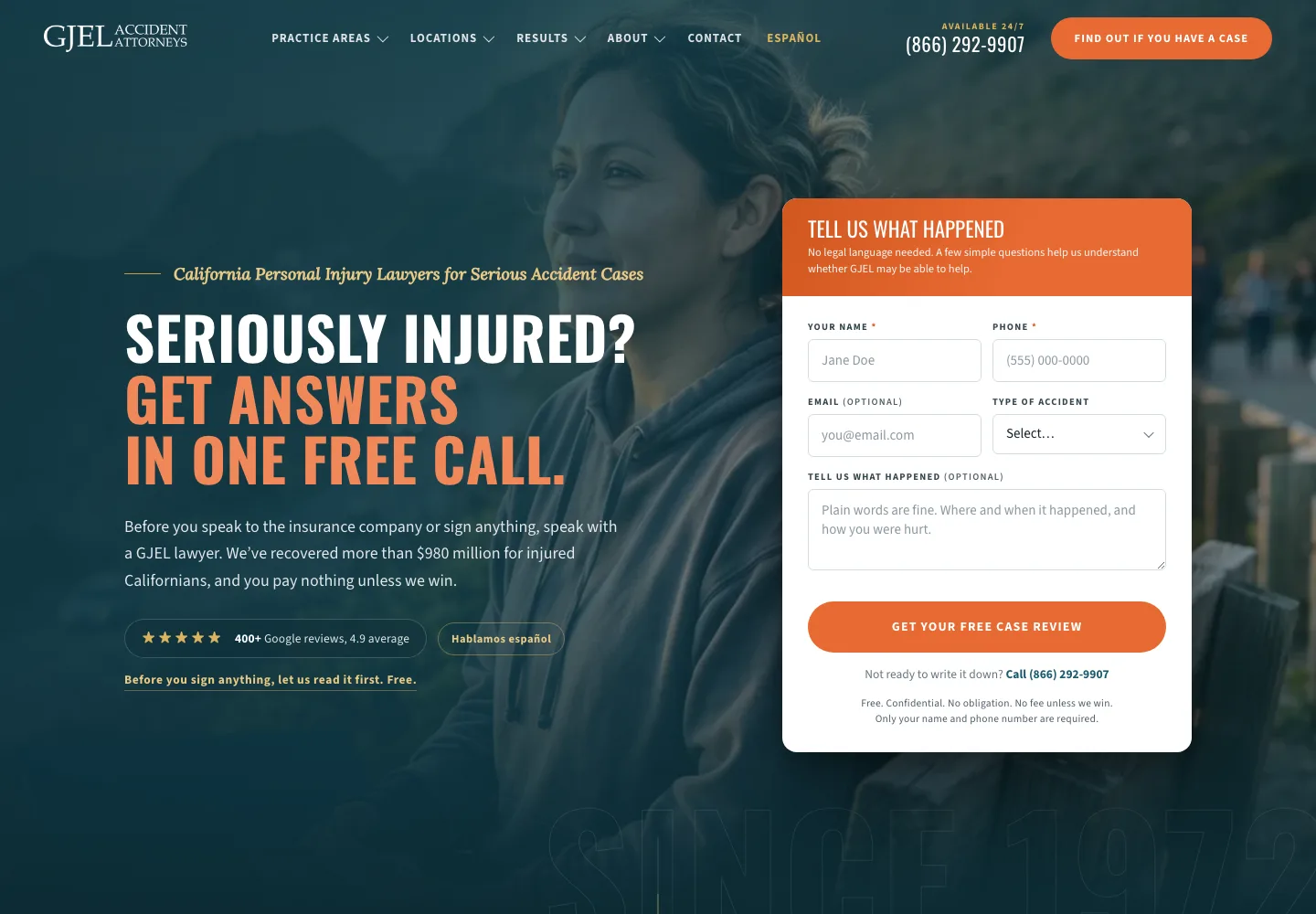
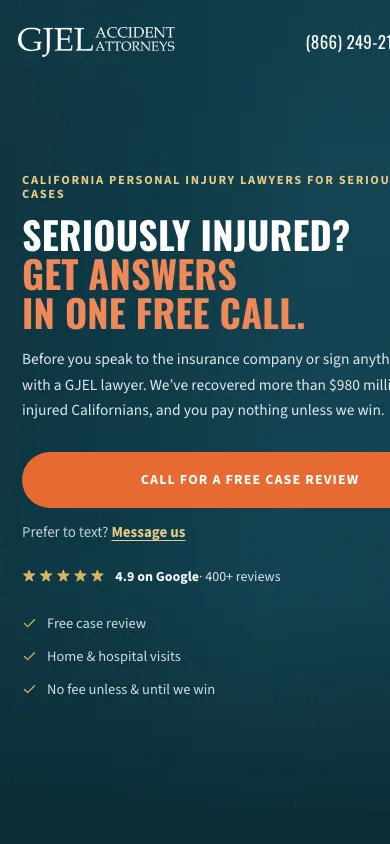 GJEL Accident AttorneysWebsite design by Juris Digital
“I was most impressed with their ability to understand my ideas and immediately incorporate them into the design of the site, making the process easy and painless.”
Featured StoryBrand example
The GJEL homepage starts with the questions an injured person or family member is already asking. It names the pressure they face, gives the firm the role of guide, turns the process into three clear steps, and repeats one useful action: find out whether GJEL may be able to help. That is what StoryBrand looks like when it becomes a working website. The message, page structure, proof, forms, desktop experience, and mobile experience all point in the same direction.
Visit GJEL.comAn injured person or family member looking for a straight answer.
Insurer pressure, bills, missed work, and uncertainty about what happens next.
A law firm that explains fit and the next step in plain language.
One repeated case-review path that moves from question to clear next step.
StoryBrand-led website
California personal injury firm. StoryBrand-led structure, a clear serious-injury message, responsive intake, and one repeated next step.
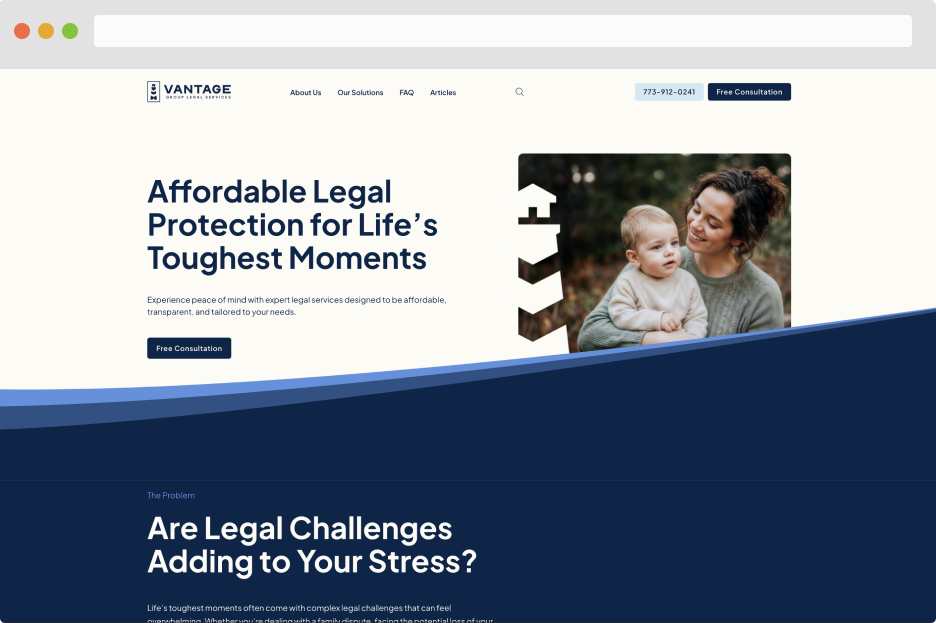
Fully custom, StoryBrand-designed website
Family law and estate planning; large-market firm. A broad firm story organized into a focused client journey.
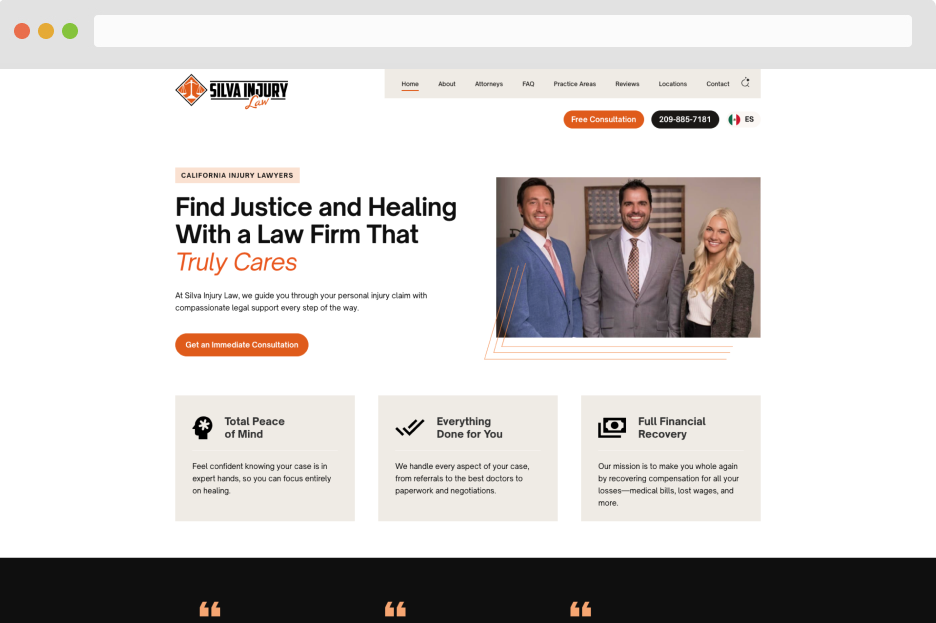
Fully custom, StoryBrand-designed website
Personal injury. A distinct visual system paired with a clear path to help.
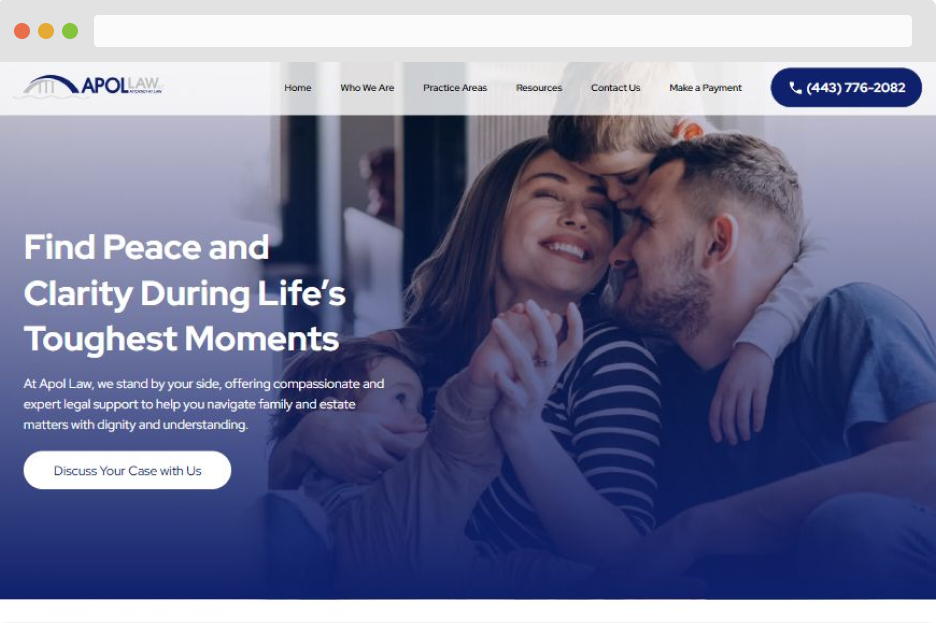
Launchpad website
Smaller family and estate-planning firm. A focused launch with a compact scope.

StoryBrand-designed website
Trusts and estates. A service story shaped around the client’s problem and next step.
Every project starts with the firm’s audience, offer, content, and operational reality.
Explore the full portfolioWhen a rebuild makes sense
A redesign is worth discussing when the current site creates doubt, confusion, or extra work. We identify the business problem first, then decide what the website needs to change.
New practice areas, attorneys, offices, or markets no longer fit the navigation or message.
The website makes visitors work to understand what the firm handles, why its experience matters, or what to do next.
The reputation that brought someone to the site is stronger than the message, proof, or experience they find there.
Staff avoid useful updates because the CMS, templates, or approval process make routine changes risky.
Pages, links, metadata, and duplicate paths need an inventory and a deliberate migration plan.
Calls, forms, scheduling, chat, or CRM handoffs create extra work for prospective clients and the team responding to them.
A useful rebuild solves a client, content, intake, or ownership problem the current site cannot handle well.
Explore PartnershipChoose the right project shape
The proposal identifies the exact deliverables after we understand the audience, content, platform, integrations, migration needs, and decision process.
For a new firm or a firm with a clear, narrow scope. We define the essential story, pages, design system, contact path, and launch requirements as a complete standalone project. Ongoing marketing is optional.
For a firm that needs deeper message strategy, content architecture, more unique page types, integrations, or a careful migration. GJEL shows how one client story can guide the experience across a substantial site.
Juris Page is a separate option for some startup and small-firm needs. After learning what the firm needs, we explain how it differs from a standalone build and recommend the appropriate path.
The work can include positioning, current-site inventory, page planning, legal content writing or refinement, user paths, wireframes, and a visual design system.
Responsive front-end and CMS development can connect forms, scheduling, chat, call tracking, CRM, analytics, and other agreed systems.
The scope can cover redirects, metadata, canonicals, internal links, accessibility and performance fundamentals, browser and form QA, training, and agreed post-launch support.
Design for the next useful step
The website should connect what brought a visitor here with the proof and action they need next. We design that path before polishing individual pages.
Practice and location paths meet the questions a client actually brings.
Positioning, attorney voice, and useful explanation build context.
Credentials, reviews, case experience, and process support the decision.
Calls, forms, and intake handoffs make the next step clear.
Launch protection
Changing the design is only one part of a rebuild. Existing URLs, useful content, links, metadata, forms, analytics, and integrations need a deliberate path to the new site.
Record current URLs, content, metadata, forms, integrations, and intentional internal links before changing them.
Identify what stays, improves, combines, retires, or redirects, with a clear owner for each decision.
Prepare redirects, canonicals, metadata, indexability, and internal-link changes around the final content plan.
Check forms, phone links, analytics, connected systems, responsive behavior, keyboard access, and browser behavior before launch.
Confirm the real deployed pages, links, images, metadata, tracking, and integrations after release.
Recheck the deployed site and watch search, behavior, and inquiry quality as real data becomes available.
These checks reduce avoidable migration risk. Search visibility and lead outcomes still depend on the starting site, market, scope, and work after launch.
How we think about law firm websites
A strong website can do more than arrange familiar sections. The format, message, and interaction should make a useful idea easier to grasp.
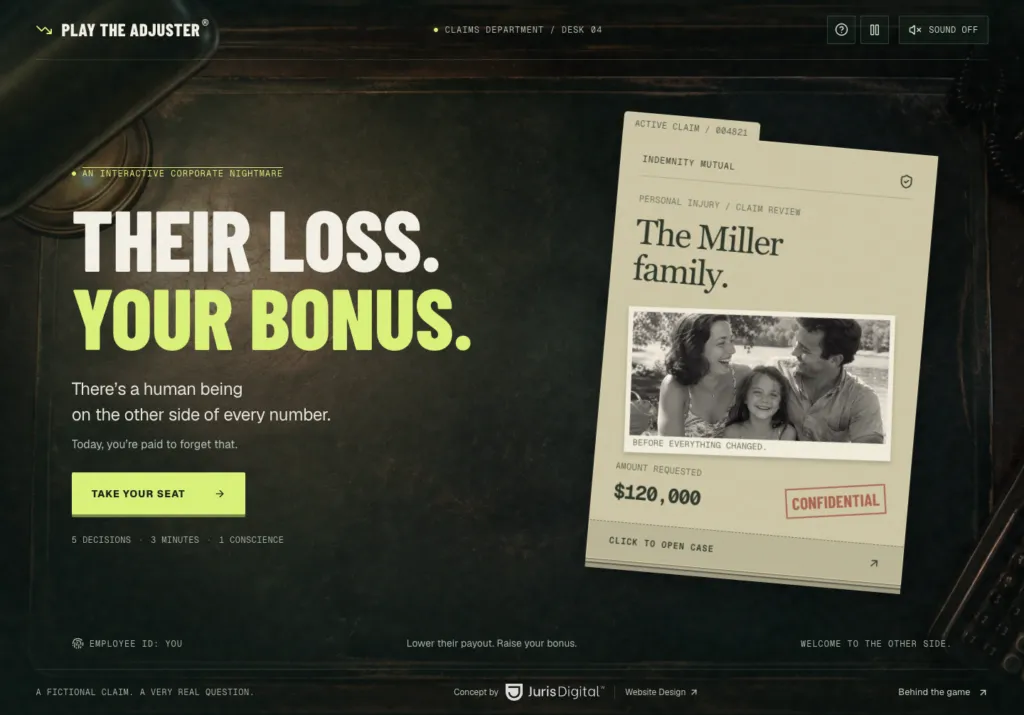
Interactive storytelling
Juris Digital built Play the Adjuster as an interactive storytelling experiment. A visitor takes the insurer’s role, makes decisions, and sees the human consequences change. It shows the principle we bring to website work: give the visitor something useful to understand or do. Interactive timelines, checklists, calculators, and scenarios are scoped possibilities, not automatic deliverables.
Play the AdjusterShow the idea
For Juris Digital’s Spanish website service, the team translates several of a prospect’s own pages before the commitment. The buyer can judge the idea through the firm’s real homepage and practice pages rather than an abstract pitch. A story map, selected wireframe, or focused concept can make a key decision concrete; any preview work is defined in the project scope.
Spanish websites for law firmsBuild something memorable
A distinctive website can carry a repeatable point of view through color, language, photography, attorney personality, and proof. When useful, the site can also become the home for an original study, calculator, practical guide, book, video series, or focused podcast. Authority assets are separately scoped around the firm’s audience and goals.
Law firm marketing ideasFrom decisions to launch
Each phase has a Juris Digital deliverable and a decision or approval from your firm. The schedule is scoped around the work and the people involved.
We clarify goals, desired work, audiences, the current site, constraints, and how the project will be judged.
Your firm’s partIdentify decision-makers, priorities, required integrations, and legal or brand constraints.
We develop the message, content inventory, page plan, and user paths.
Your firm’s partSupply source material, confirm accuracy, and resolve stakeholder feedback.
We produce the agreed wireframes, visual system, responsive templates, content, and working CMS experience.
Your firm’s partReview milestone decisions and give consolidated approvals.
We run the scoped migration, integration, responsive, accessibility, analytics, and launch checks.
Your firm’s partApprove launch, confirm ownership and access details, and assign the people who will manage the site.
From the team
Cally Jacque, our art director, on the details that help a visitor take the next step.
The people behind the work
Your website moves through visual direction, design, project coordination, and technical development. Meet the Juris Digital people who help bring that work together.

Art Director
Turns client goals and big ideas into brand-centered visual direction.
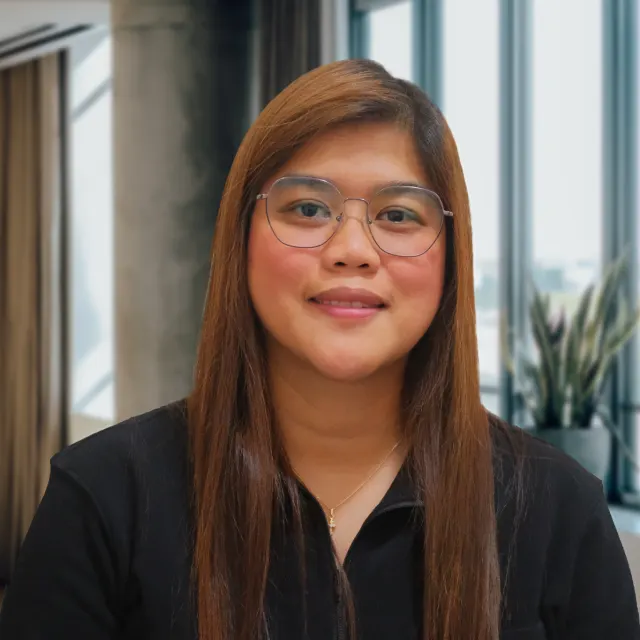
Website Designer
Designs websites with a creative eye and an interest in the technology behind the experience.
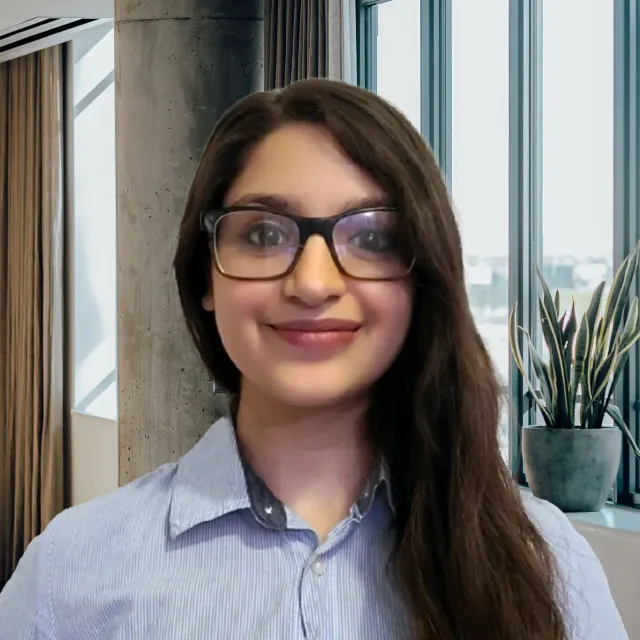
Web Designer
Specializes in UI and UX for websites that are visually engaging and built around conversion.
Digital Project Manager
Coordinates website work from initial concepts through development and launch, alongside clients and development teams.

Director of Technology
Leads technology work with a focus on WordPress development, technical SEO, and page speed.

Senior Developer
Supports development delivery, infrastructure, code quality, and performance across client sites.
Scope, platform & ownership
Your firm’s goals, content needs, design depth, integrations, platform, and migration complexity shape the scope. Start with a conversation, and we will recommend the project path and prepare a proposal around the work required.
WordPress can fit a content-rich firm with many practice and location pages, established publishing workflows, and complex integrations. A lighter CMS can fit a focused site when simpler editing, less maintenance, or a different development approach matters more. We recommend the platform after reviewing the content model, integrations, editors, scale, hosting needs, and portability requirements.
The proposal documents the treatment of the domain, content, CMS and code access, credentials, design source files, photography, fonts, plugins, third-party licenses, analytics, hosting, training, support, and any recurring services. We walk through the details so the firm knows what it will control at launch and which outside licenses or services remain separate.
What website clients say
They understood what I wanted.
“I was most impressed with their ability to understand my ideas and immediately incorporate them into the design of the site, making the process easy and painless.”
The website is awesome and the process was painless.
“I was blown away by their initial presentation, hired them immediately, and never looked back. I trust Juris Digital to manage my online presence.”
They did a wonderful job designing the website.
“I hired Juris Digital to redesign my law firm's website and take care of SEO and digital advertising. All I can say is wow.”
Practical questions
Bring the questions that matter to your firm. We will put the answers that affect scope, control, and launch in the proposal.
Explore PartnershipYes. Juris Digital can plan, design, build, and launch a website as a standalone project. Ongoing marketing is optional.
Your firm’s goals, content needs, design depth, integrations, platform, and migration complexity shape the scope. Talk with us first, and we will recommend the right project path and prepare a proposal around the work required.
We scope the schedule individually. Content volume, unique page types, integrations, migration work, asset readiness, and stakeholder review all affect the plan.
Yes. Juris Digital can write new legal marketing content or refine existing material when content is part of the agreed scope. The proposal defines the pages, review process, and responsibilities.
No. We can use WordPress or an agreed lighter CMS. We recommend the platform after reviewing the content, editors, integrations, hosting, and handoff requirements.
We can inventory the current site, map redirects and canonicals, carry forward useful content and metadata, test indexability and internal links, and verify the deployed site. Those steps reduce avoidable migration risk, but no one can guarantee unchanged rankings.
The proposal documents the domain, content, CMS and code access, design files, credentials, hosting, and third-party licenses so the handoff is clear before work begins. Ask us to walk through any ownership or portability requirement that matters to your firm.
We define training, warranty, hosting, maintenance, and post-launch support in the project scope. Ongoing SEO, content, or paid media can be considered separately when useful.
Useful next reads
Browse examples, compare providers, and clarify how design should support the firm’s marketing.
Your next website project
Tell us your current URL or new-firm status, the clients and work the site should support, the approximate content scope, the systems it needs to connect to, and any timing constraint. We will help identify the right next step.
Juris Digital is a law firm website design company building fast, accessible, mobile-first WordPress sites that firms own. Information architecture, legal content, SEO, analytics, and conversion paths are designed together so organic, AI, and paid traffic reaches a credible experience that turns attention into qualified inquiries and signed cases.
This work connects with the other JurisOS™ pillars, including Discovery, technical and local Standing, Authority through GEO and legal content, Retain through paid media and conversion, and Precedent through signed-case attribution and scaling.
Law Firm Website Design and Conversion Optimization operates inside JurisOS™ Pillar 02: Standing. The service is planned with the other pillars so visibility, authority, paid acquisition, website conversion, and intake measurement support one accountable path to qualified inquiries and signed cases.
Juris Digital evaluates performance beyond impressions, clicks, or rankings. Reporting connects channel activity to qualified inquiries, intake outcomes, signed cases, and cost per signed case wherever the firm’s tracking and CRM data make that attribution available.