There was a time when search strategy was simple. You ranked. You got clicks. You grew. Well, maybe it was easier said than done.
If your firm held a top-three position on Google, you had a predictable pipeline. That model shaped an entire generation of legal marketing strategy. While that model still exists, it is changing quickly due to generative search. So are blue links dead?

Yes and no. Really, what’s dead is traditional ranking being the only factor in search marketing. For example, people are starting to use generative search results more and more. That shift alone is forcing firms to rethink what the future of search rankings actually looks like.
TL;DR — Key Takeaways
- Ranking #1 organically doesn’t guarantee visibility anymore. AI overviews, ads, and snippets often push traditional results down the page.
- Your content now feeds answers, not just clicks. AI tools pull from multiple sources, so your goal is to be included—not just ranked.
- Discovery now happens across multiple platforms. Clients are searching on ChatGPT, YouTube, Reddit, and more.
- Bonus tip: Search your own practice areas in ChatGPT and Google AI Overviews. If your firm isn’t mentioned anywhere in the answer, that’s your starting point.
The Slow Fade of the 10 Blue Links
Blue links aren’t disappearing quite yet, but their dominance is. Actually, they’ve been “dying” for the past decade, depending on who you ask. Some SEO specialists have been warning of this since before AI was on the scene.
While the phrase “Google blue links dying” gets thrown around a lot, it’s a bit dramatic. However, it points to a real shift that has been slowly happening for years. Traditional organic results are being pushed further down the page by:
- AI Overviews,
- Local Service Ads,
- Knowledge panels, and
- Featured snippets.
In many cases, users get what they need before they ever scroll. That’s especially true in legal search. AI overviews for legal search now summarize next steps, explain liability, or outline timelines right at the top of the results page. And, if they don’t appear, they’re usually replaced by a featured snippet. Here are a couple examples of that in action.

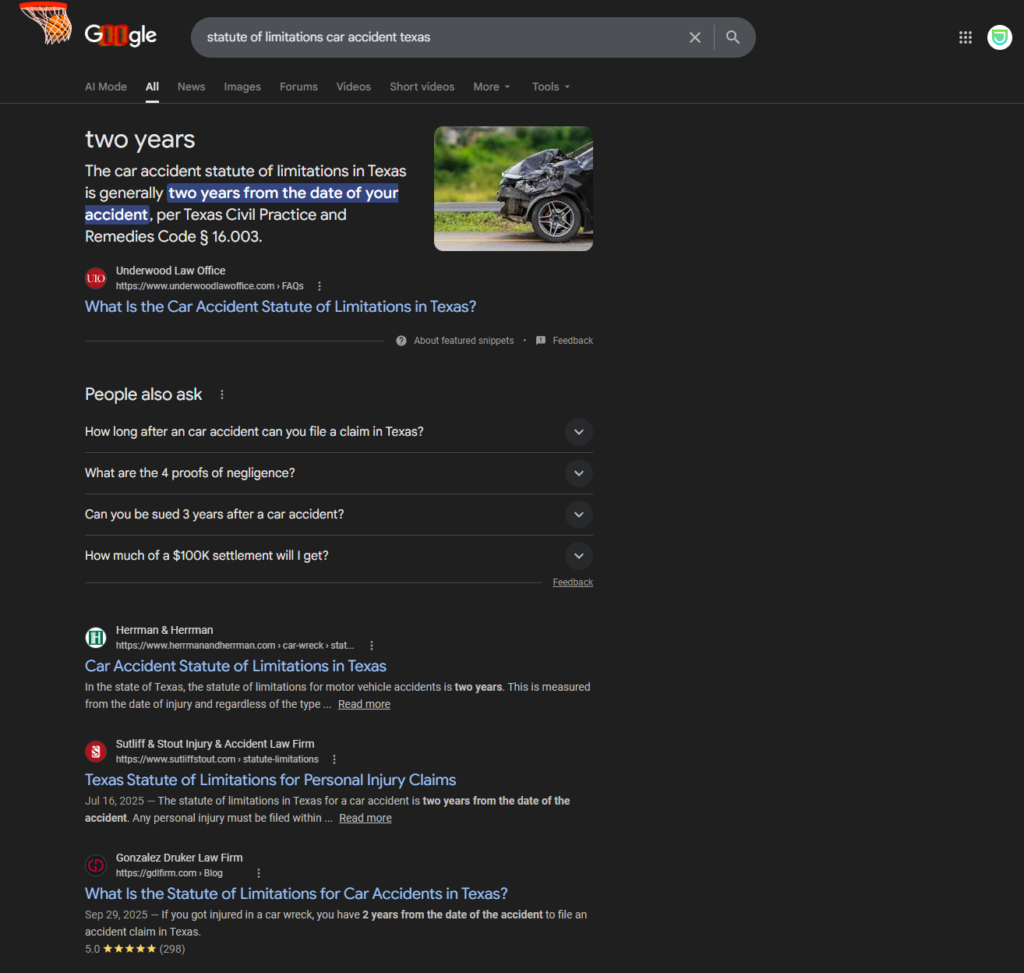
As a result, ranking #1 doesn’t guarantee visibility the way it used to. Being the first means your link appears somewhere near the middle or bottom of the first SERP.
That’s the first crack in the old model for the future of search rankings.
Search Now Focuses Specifically on Answers
The bigger shift in search is behavioral. We’ve learned over the years that long-tail keywords have value even if they have low search volume. That’s because users searching those keywords needed an immediate, specific answer.
As a result, search engines are no longer just directories. They’re becoming answer engines. A prospective client doesn’t always want a list of websites. They want answers to questions like:
- “What should I do after a car accident?”
- “Can I sue for wrongful termination?”
- “How long do I have to file a claim?”
Platforms like ChatGPT, Perplexity, and Google’s AI Overviews now respond with full answers, often pulling from multiple sources and presenting a single, synthesized response.
That changes the role of your website. Instead of being the destination, your content becomes a potential ingredient in the answer. That’s the fundamental shift in how the future of search rankings works. In fact, AI-referred sessions grew by more than 500% between 2024 and 2025, so if that trend continues, it’s likely that traditional search will evolve to be more answer-oriented.
Another way to think about this shift is through the lens of “search everywhere” in legal marketing. People aren’t just searching on Google anymore like they used to. Instead, they’re asking questions in:
- ChatGPT,
- Perplexity,
- YouTube,
- Reddit,
- LinkedIn, and
- Voice assistants.
Each of these platforms surfaces information differently. Some rank while others recommend or summarize. For law firms, that means discovery is now fragmented across dozens of environments. If you’re not targeting these other platforms, you’re missing out on potential clients.
Why Rankings Alone Don’t Tell You Much Anymore
Here’s where a lot of firms get stuck. It’s easy to think that you can still measure success the old way, whether that’s keyword rankings or organic traffic. While those things still matter in the grand scheme of your marketing strategy, they don’t tell the full story. For example:
- Your content might be cited in an AI Overview without generating a click;
- A user might learn from that content, then search your firm by name later; or
- Your visibility might influence a decision even if it never shows up in analytics.
This creates what many marketers are starting to recognize as an “invisible influence layer,” primarily driven by zero-click search. If anything, this is the reason why the future of search rankings can’t be measured solely by traffic anymore.
The Rise of Zero-Click Search
Let’s go over exactly what a zero-click search is. At a basic level, zero-click search means the user gets what they need without ever visiting a website. They search, read the answer on the results page, and move on.
As of March 2025, 27.2% of search traffic in the U.S. ends without a click. Basically, more users are searching for an answer, finding the answer on the SERP, and leaving. You might provide the information that helps a potential client understand their situation, but they may never click through to your site. However, that doesn’t mean your content didn’t influence the decision. It just means that influence happened earlier in the process.
What Law Firms Should Do Differently
If rankings alone aren’t enough, what should firms actually focus on? At a high level, law firms should broaden the way they approach their marketing strategy. This means that your firm should:
- Answer questions directly. Content that gets to the point quickly is far more likely to show up in AI-generated responses.
- Build authority beyond your website. Consistency across directories, publications, and profiles reinforces credibility.
- Structure content clearly. Headings, lists, and defined sections make your content easier to use for both people and AI systems.
- Look beyond rankings. Visibility now includes where your firm is mentioned, cited, and discussed.
This is the practical side of the future of search rankings: showing up in more places, not just higher positions. If you want a more in-depth look at how to rank for generative search, check out the other post I’ve written below.
Related: How to Get Your Law Firm Cited in ChatGPT and Perplexity Searches
What This Means for Your Firm’s Search Strategy
Search is changing in a way that isn’t always obvious from your reports. Your firm may still rank well. Traffic may still look steady. But more of the decision-making process is happening before someone ever clicks a result. AI summaries, citations, and aggregated answers are shaping how potential clients understand their situation and who they trust.
That’s where the future of search rankings is headed.
A lot of firms are starting to notice the disconnect. Rankings look fine, but it’s harder to explain where new leads are coming from or why certain leads feel less predictable.
The firms that adapt are the ones paying attention to where they show up, not just where they rank. They’re looking at how their content is being used, whether their authority is consistent across platforms, and whether they’re present in the places clients are actually getting answers.
If you want to take a closer look at how your firm is showing up today, we’re happy to walk through it with you. We can have a practical conversation about what’s working, what isn’t, and where this is all heading.
Last updated: