One of the first things many new law firm owners discover is that local visibility gets expensive…fast.
You search your practice area, see competitors everywhere in the Map Pack, and within a few days someone is trying to sell you a $500/month “local SEO package” that sounds suspiciously vague. Usually, it involves the words authority and citations being repeated until everyone stops asking questions.
The good news is that ranking locally is not purely a spending contest.
A newer firm absolutely can compete in local search without pouring money into ads every month. In fact, a lot of what determines how you rank in the Google Map Pack as a law firm comes down to consistency, relevance, and trust signals that many established firms still neglect. That’s especially true now that Google relies so heavily on reviews and business profile quality to determine visibility.
The mistake many new firms make is assuming they need to outspend older competitors immediately. In reality, the better approach is usually to become more locally relevant and more operationally consistent than firms that have been coasting on age and brand recognition for years.
That’s where things like reviews, profile optimization, local content, and engagement signals start to matter disproportionately. A well-built local presence can still outperform firms spending heavily but managing their profiles poorly.
So, before you assume you need a giant monthly budget, it’s worth understanding what Google is actually rewarding in local search and where smaller firms still have room to compete.
TL;DR — Key Takeaways
- You do not need a massive budget to compete locally. A strong foundation is often more important than spending heavily on ads.
- Your Google Business Profile does a lot of the heavy lifting. Completing and actively maintaining your profile is one of the most important parts of Google Business Profile optimization.
- Reviews influence both rankings and conversions. Consistent review growth helps Google trust your firm and helps potential clients trust you too.
- Bonus tip: Search your own practice area and city in Google, then compare your profile side-by-side with firms in the Map Pack. Usually, the gaps become obvious pretty quickly—fewer reviews, weaker descriptions, missing photos, or less locally relevant content.
What Actually Moves the Needle in Local Rankings
A lot of law firms overcomplicate local SEO because the industry around it tends to overcomplicate it.
In reality, Google’s local algorithm is trying to answer a fairly simple question:
“Which law firm seems the most relevant, trustworthy, and active in this area?”
If your Google Business Profile is incomplete, your reviews are inconsistent, your website barely mentions your city, and your competitors are actively updating their profiles every week, spending more money usually won’t fix the underlying issue.
This is where people often misunderstand how to rank in the Google Map Pack as a law firm. They assume local visibility is mostly driven by ad spend or firm size. But the Map Pack works differently than traditional PPC.
Google looks at a combination of signals, including:
- How complete and active your business profile is;
- Whether your reviews appear legitimate and consistent;
- How clearly your website reinforces local relevance; and
- Whether your business information matches across the web.
None of those things require a massive budget. A solo attorney with a well-optimized profile, strong reviews, and locally relevant content can quietly climb past larger firms that are doing the bare minimum.
If you want some ways that you can boost your local rankings without spending much, here’s a checklist we made to help you get started.
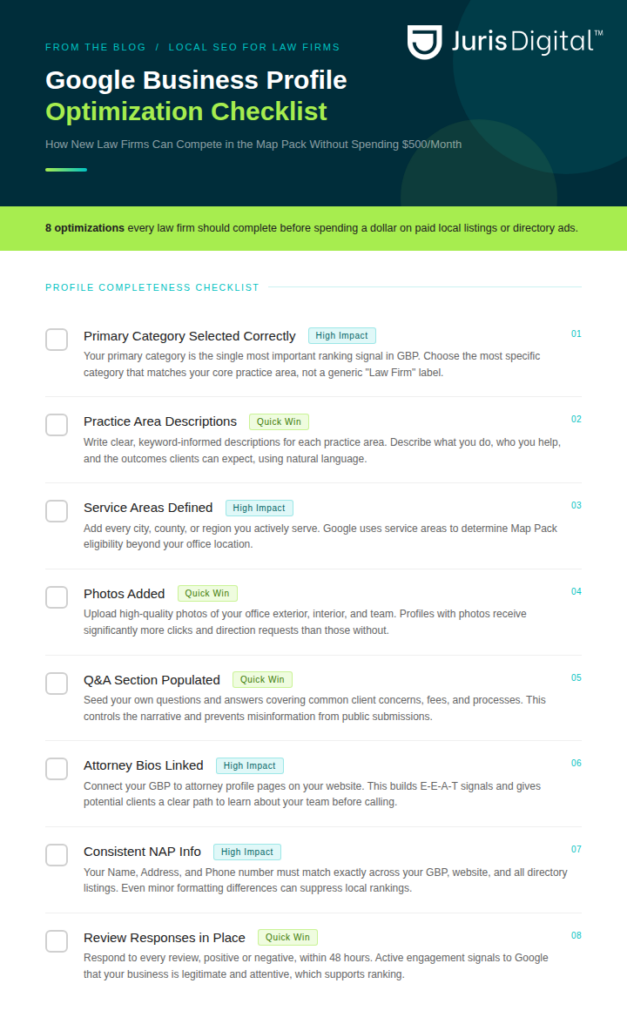
1. Fully Complete Your Google Business Profile
This sounds obvious, but it’s one of the most common problems we see with newer firms.
A partially completed Google Business Profile sends weak signals. Google wants confidence that your business is legitimate, active, and clearly connected to a specific practice area and location. If important sections are missing, the signal is weaker. This is the foundation of Google Business Profile optimization for lawyers.
At a minimum, your profile should include:
- A clear primary category (usually your main practice area),
- Accurate office hours,
- A detailed business description,
- Practice area services,
- Photos of the office and attorneys,
- A linked website, and
- Consistent contact information.
The business description matters more than many firms realize. Don’t just write, “We are experienced trial lawyers serving clients in Colorado.” That says almost nothing.
Instead, describe what the firm actually handles and where. A profile that references things like DUI defense, car accidents, or divorce in Denver gives Google much stronger local relevance signals.
Photos also help more than people think. A profile with real office photos, attorney headshots, and updated imagery tends to look more trustworthy to both Google and potential clients.
This is one of the easier ways to improve rankings without spending heavily. Most firms aren’t losing local visibility because they lack some secret tactic. They’re losing because their profile looks unfinished or inactive compared to competitors nearby.
Related: Why Law Firm Marketing Costs Skyrocketed in 2025 (And What Comes Next)
2. Build Reviews Consistently (Not All at Once)
If there’s one thing newer firms underestimate in local search, it’s how much reviews influence visibility.
Google reviews affect two things at the same time:
- Whether your firm appears in the Map Pack, and
- Whether someone actually clicks once you do.
That’s why law firm reviews matter so much for local SEO. They’re both a ranking signal and a trust signal. Here’s a brief clip from episode 4 of our podcast A Non-Billable Hour where our Director of Strategy discusses the importance of reviews for firms looking to save money.
A lot of firms approach reviews the wrong way, though. They treat them like a one-time project. After a good settlement or successful case result, they suddenly send ten review requests in a week and then disappear for six months.
What Google tends to reward is consistency. A steady stream of legitimate reviews over time usually carries more weight than sporadic bursts.
This is also the most practical answer to how to get more Google reviews for a law firm: build the request process into your operations instead of relying on memory.
Some firms ask for reviews:
- After a successful hearing,
- After a case closes, or
- During offboarding when the client is happiest.
The exact timing matters less than making it repeatable.
And most importantly, don’t overcomplicate the ask. Most clients will not leave a review unless you make it extremely easy. Direct links, simple instructions, and a short personal request usually outperform any other method of gathering reviews.
For firms trying to figure out how lawyers can rank in the local pack without ads, reviews are one of the few levers that directly influence both visibility and conversion at the same time.
Want to listen to the full episode of the podcast? Take a listen below!
3. Make Your Website Look Local
This is one of the simpler ways to rank in the Google Map Pack as a law firm that is often overlooked. A surprising number of law firm websites barely mention where the firm actually practices. From Google’s perspective, it’s confusing at best or untrustworthy at worst.
You don’t need to stuff city names into every paragraph. In fact, that usually makes the content worse. What matters is making it obvious that your firm is tied to a real geographic area.
That can happen naturally through:
- City-specific practice area pages,
- References to local courts or procedures,
- Attorney bios mentioning local experience,
- Office location details, and
- Locally relevant FAQs.
For example, a personal injury page that explains the statute of limitations under Colorado law sends a much stronger signal than a completely generic statute of limitations page for other types of lawsuits.
The same goes for your contact page. Include the full office address, embedded map, nearby landmarks if relevant, and consistent contact information. Google uses those details to reinforce geographic relevance across your online presence.
This is also where newer firms have an advantage. Smaller firms can often build more focused local content because they serve a narrower area. Larger firms sometimes spread themselves thin trying to optimize for every city within a hundred-mile radius.
You Don’t Need a Huge Budget to Compete Locally
A lot of newer firms assume they’re automatically at a disadvantage because they don’t have years of reviews, a massive ad budget, or an established brand. That’s not really how local search works anymore.
Google cares a lot about trust, relevance, and consistency. If your profile is active, your reviews are growing steadily, and your website clearly reinforces where and what you practice, you can compete much sooner than most firms expect. That’s really the core of how to rank in the Google Map Pack as a law firm.
And honestly, a lot of established firms have stopped paying attention. Their profiles are outdated, their reviews are inconsistent, and their websites barely support their local presence. That creates room for smaller firms willing to do the fundamentals well.
If you want a clearer picture of how your firm is actually performing locally, schedule a quick strategy call with us. We’ll walk through your current local presence, identify the biggest gaps, and show you where smaller changes can create the fastest movement.
Ready to Elevate Your Law Firm’s Marketing?
Let’s TalkLast updated: