Answer engine optimization (AEO) aims to help your content appear in direct answers. Generative engine optimization (GEO) focuses on how your firm and content appear in AI-generated responses, such as Google AI Overviews and ChatGPT search.
The terms overlap. For your law firm, the goal is to help the right potential clients discover your firm, understand whether you can help, and contact you. Neither term replaces the need for a useful, trustworthy website.
What is the difference between GEO and AEO?
Scroll sideways to review every column.Each row is shown as a labeled card.
| Term | Plain-English emphasis | Example |
|---|---|---|
| SEO: search engine optimization | Help people find relevant pages and business information through search. | A person finds a firm’s practice-area page in Google. |
| AEO: answer engine optimization | Help your information be useful as a direct answer. | Google shows a sourced excerpt answering a prospective client’s question. |
| GEO: generative engine optimization | Improve how your firm and information appear in generated answers. | An AI response cites a firm’s guide or names a firm among options. |
These activities overlap. You do not automatically need three separate marketing programs.
What does this look like on Google and ChatGPT?
A citation here means a linked source beside an answer. It is not a legal citation or proof of a website visit.
Google AI Overview: an answer with sources
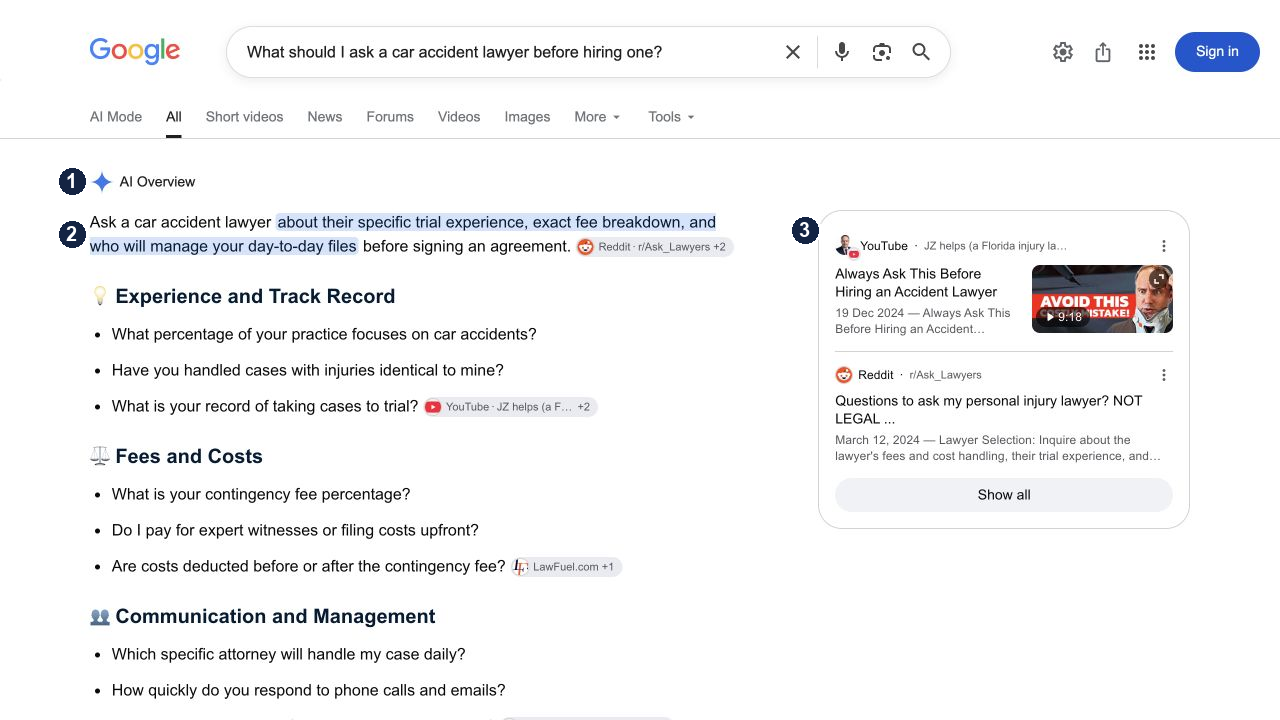
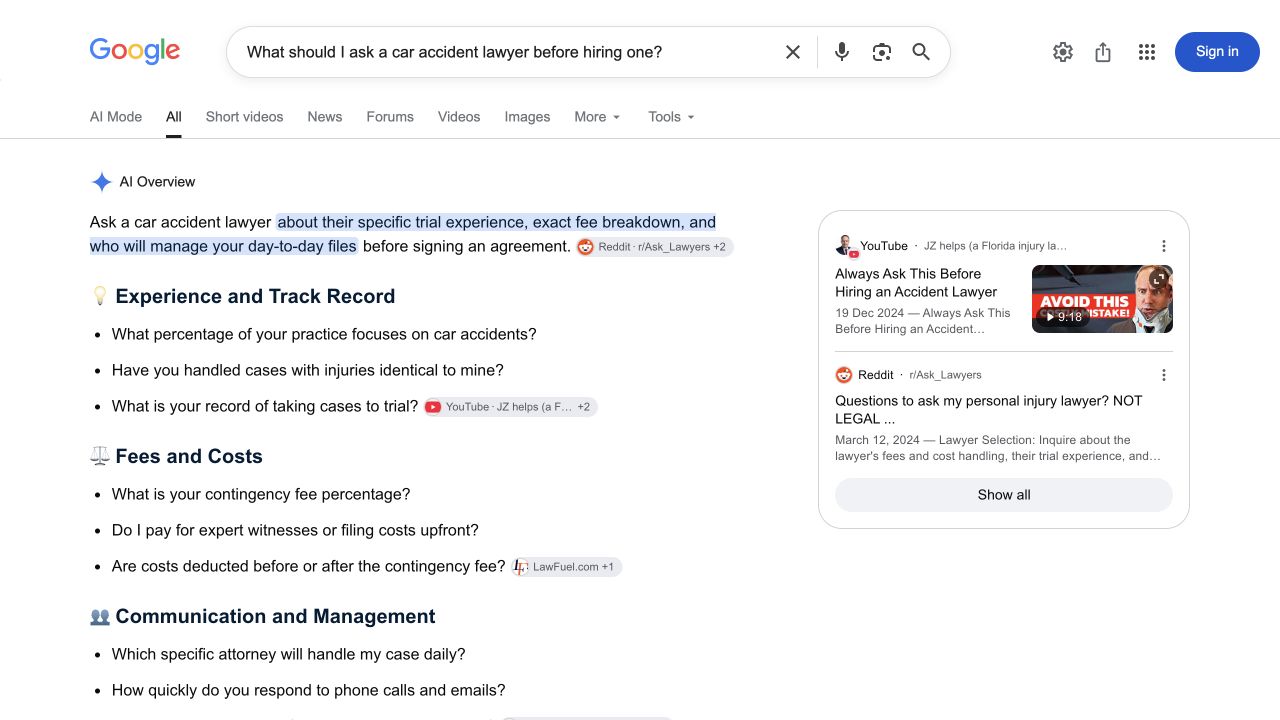
An AI Overview can bring information from multiple sources into a generated response. When someone asks what to discuss with a car accident lawyer, the answer may show guidance and links to investigate. The answer text, a firm’s name in that text, and a link to the firm’s page are three different observations. A screenshot of any one of them does not show that a prospect clicked or hired the firm.
Google featured snippet: a direct answer
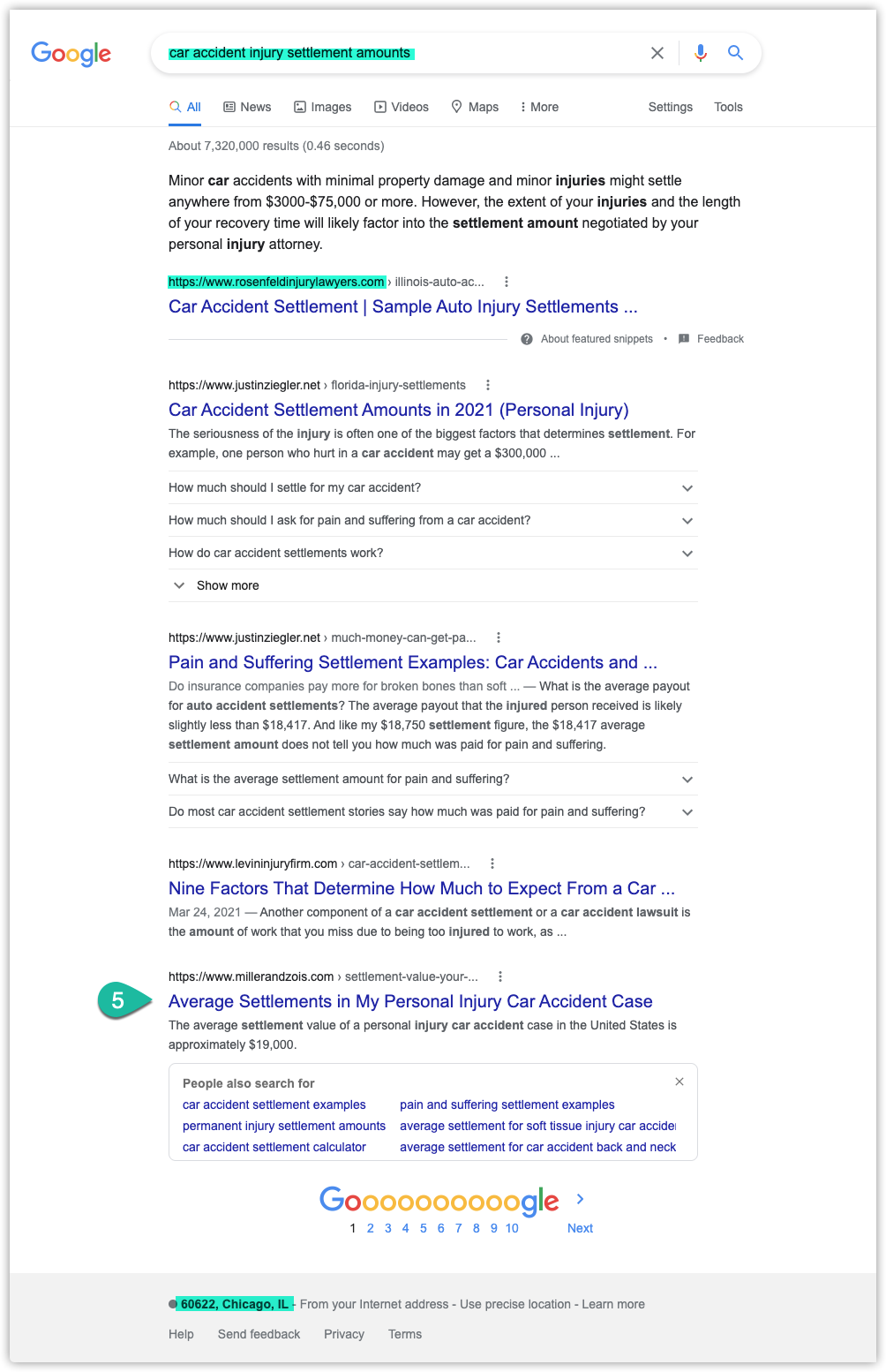
Google may lift a short excerpt from a web page and identify its source. This historical example answers a question about accident settlement amounts. A firm’s appearance as the source is visibility, but it is not yet a visit or a client. Google calls this feature a featured snippet; an expanded People Also Ask answer is a related direct-answer example.
ChatGPT search: a generated response with links
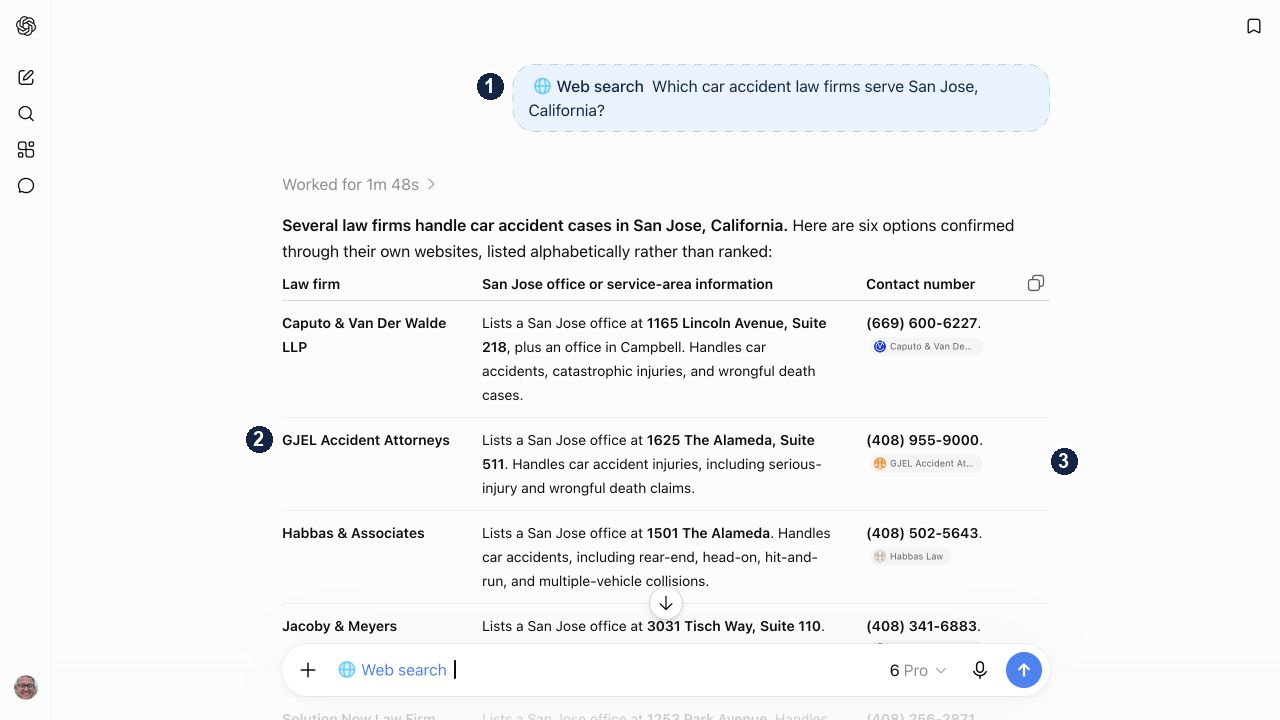
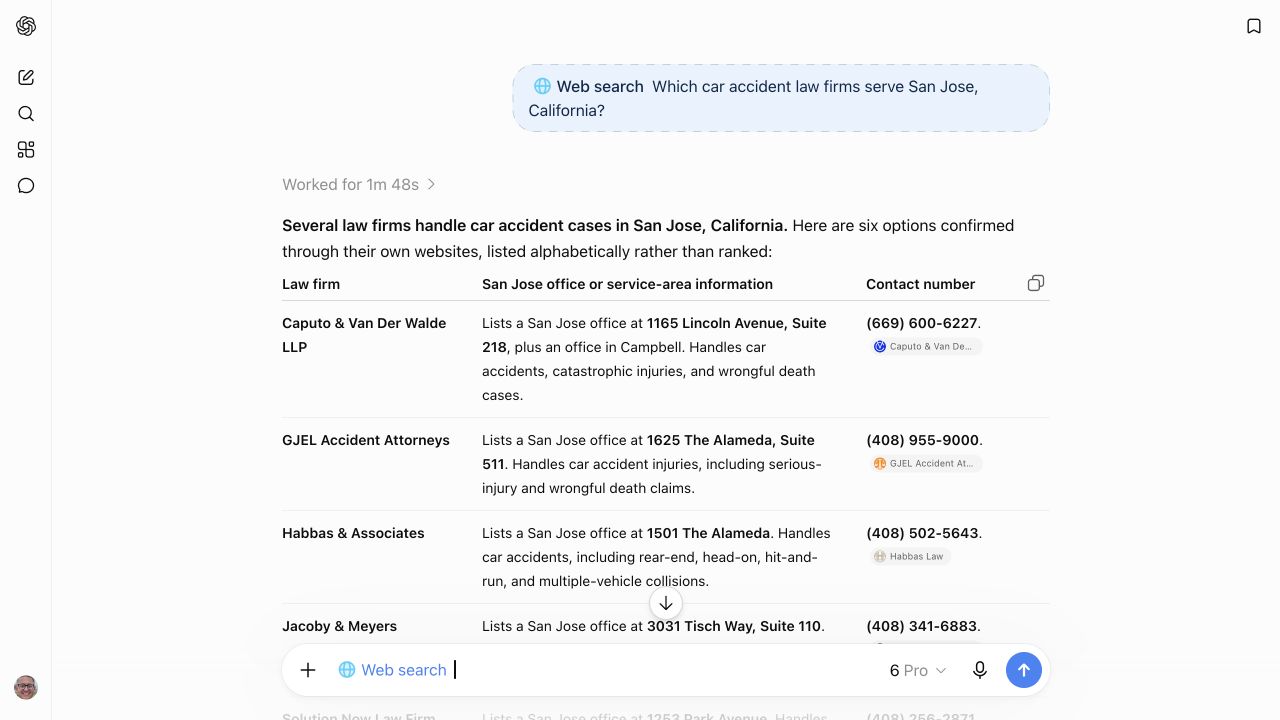
ChatGPT can search the web and may show links to sources. For a question about car accident firms serving San Jose, an answer might name firms and cite different pages. A named firm is not necessarily a cited source. The result can vary by time, location, and wording, and the answer can be incomplete or wrong. Check the linked source before treating a factual claim about any lawyer as verified.
Google AI Mode: a search conversation
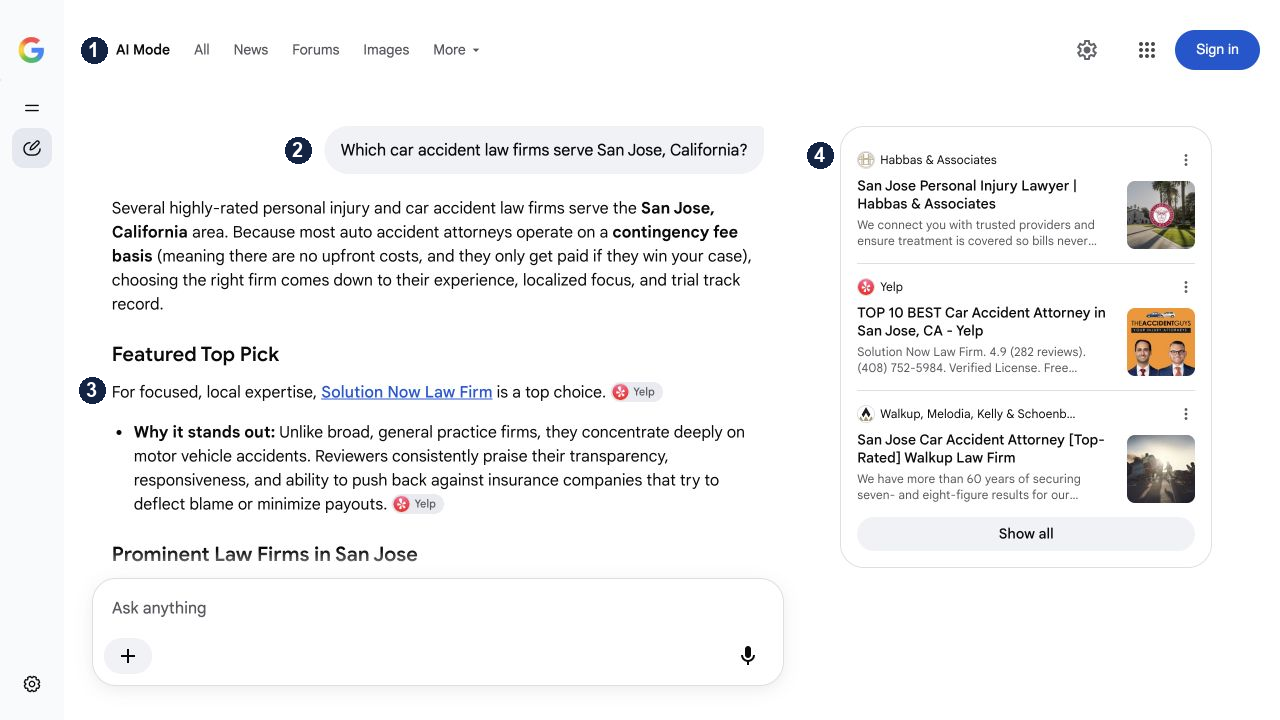
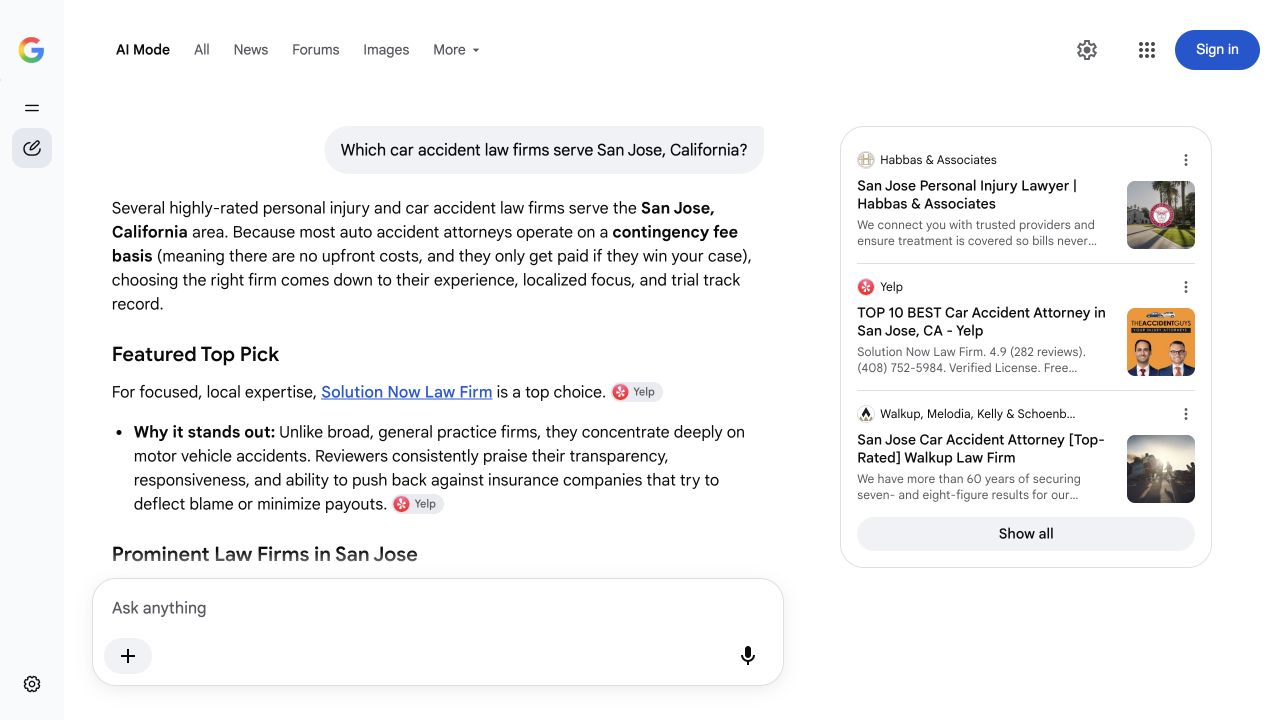
AI Mode is another Google Search experience where someone can ask a question, explore a generated answer, and follow up. It is a different interface from an AI Overview on a regular results page. The same law firm may appear differently in each. Record the exact question, date, and visible sources when you compare them.
Which AI tools are we talking about?
Scroll sideways to review every column.Each row is shown as a labeled card.
| Tool or feature | What an attorney should know |
|---|---|
| Google featured snippets and People Also Ask | Direct excerpts can answer a question and name a source. These illustrate an AEO-style objective. |
| Google AI Overviews | Generated answers can appear within regular Google results and include links to sources. |
| Google AI Mode | A separate AI search interface allows follow-up questions and source exploration. |
| ChatGPT search | A web-search response may include linked sources. Being named and being cited are different. |
| Perplexity | Conversational answers commonly present cited web sources. |
| Microsoft Copilot and Copilot Search in Bing | AI-assisted answers and search experiences can show sources to explore. |
| Google Gemini | Google’s separate assistant can provide sources and related links, but not every answer has them. It is not the same interface as Google Search. |
You do not need to master every tool. Start by understanding what people see and whether the information about your firm is accurate.
Are law firms actually hearing about ChatGPT referrals?
“I talk to a lot of our clients, including GJEL Accident Attorneys, and they’re telling me they’re hearing people talk about ChatGPT referrals. We can also track that better now, because we can see referral visits coming to the website.”
Casey Meraz, Co-founder, Juris Digital
Those conversations matter. So does the website data. We look at both, then ask a separate question: did the inquiry turn into the right kind of client?
- Visibility: A particular answer mentions the firm or links to its content.
- A visit: An identifiable website session is attributed to an AI source when available tracking supports that conclusion.
- A business outcome: Intake records show whether the inquiry qualified and became a signed matter.
OpenAI documents a utm_source=chatgpt.com tag on ChatGPT search referral URLs. It can help identify some visits, but it does not account for every path a person takes. Someone may see an answer, search again later, use another device, or tell your intake team about ChatGPT without arriving through a tagged link. Keep self-reported discovery separate from analytics attribution, and do not count the same inquiry twice. Crawler requests are not human visits.
What our own research found
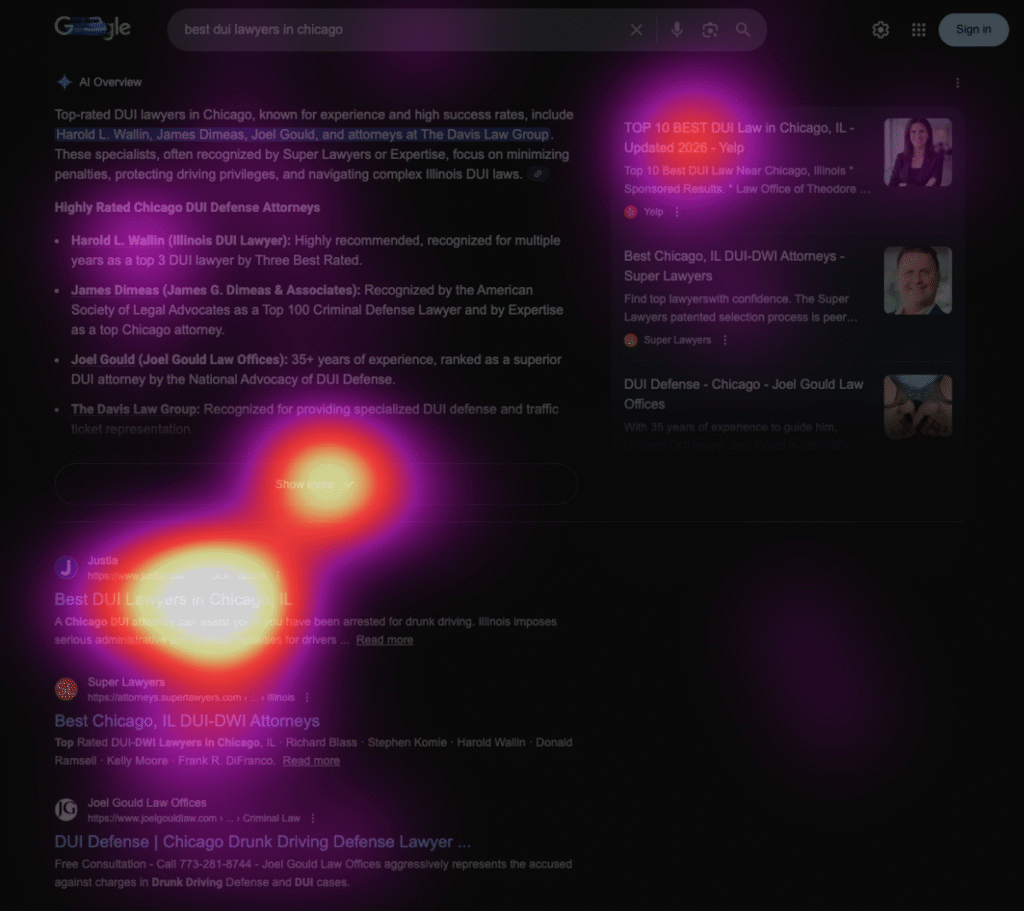
Where 140 people clicked on one legal search result
Historical research · 140 respondents · source article published February 2026; survey collection date not recorded. In our first-click study, respondents saw one screenshot for “best dui lawyers in chicago” and selected where they would click first. The heat map below shows their choices.
Scroll sideways to review every column.Each row is shown as a labeled card.
| Selected area | Respondents |
|---|---|
| Traditional organic result | 71 |
| AI expansion control | 26 |
| AI citation | 21 |
| AI Overview or mention | 16 |
| Other | 6 |
This was one screenshot test, not a measure of live conversions, market share, or all legal searches. Opening an AI answer is not the same as visiting a law firm’s site. The practical lesson is to serve readers in both traditional results and AI-assisted answers.
AI map packs in a small mobile search sample
Historical research · late November 2025 · 27 selected mobile searches. In our AI map-pack study, an AI map pack appeared in 12 of 27 tested mobile searches. That point-in-time sample shows why the interface is worth watching. It does not tell us how often AI map packs appear across today’s legal searches.
What should your law firm do first?
- Check the current answers. Ask a few nonbranded questions about the matters and markets you serve, then use branded questions to check facts about your firm. Save the question, date, visible answer, and sources. One absence does not mean the firm is invisible everywhere.
- Improve what people can verify. Keep practice pages, attorney biographies, locations, contact details, and explanations of the matters you want accurate and easy to find. Ask the responsible attorney to approve legal and professional claims. A clear practice page, real attorney explanation, approved case example, or useful video can help a potential client understand fit. As Matt Green, Co-founder of Juris Digital, writes: “It’s more important than ever for your firm to create content in a variety of formats, for a variety of channels.” The format should serve the client’s question, not a supposed ranking formula. Our legal content writing and law firm SEO services address parts of this work.
- Connect visits to intake. Ask prospects how they found you. Retain identifiable source information when available. Review qualified inquiries and signed matters separately. A screenshot or visibility score alone cannot tell you whether the right clients contacted the firm. Our intake and revenue tracking work helps connect those stages.
Our GEO services for law firms bring this work together: checking how your firm appears, improving the information behind the answers, and connecting identifiable visits with your intake process.
Check how AI describes your firm
Start with one practice area and one market. Try these three questions in the tools your potential clients may use. Replace the bracketed words. Do not include private case facts.
- Discovery:
Which [practice area] law firms serve [city, state or province]? - Fit:
Which lawyers in [location] handle [specific matter type]? - Accuracy:
What kinds of matters does [firm name] handle, and where are its offices? Include sources where available.
For each answer, record whether your firm appeared, whether the information was correct, and which sources were shown. The third question checks accuracy; it does not test unprompted discovery.
Scroll sideways to review every column.Each row is shown as a labeled card.
| Question and date | Firm mentioned? Facts accurate? | Sources shown and next correction |
|---|---|---|
| Discovery: | ||
| Fit: | ||
| Accuracy: |
Start with one practice area and one market. Check what the answers say, identify what is missing or incorrect, and decide which improvement would help a real prospective client.
Explore GEO services for your firm
A few remaining questions
Does GEO replace SEO?
No. Google’s AI Search guidance says its established search foundations still matter. Google treats GEO and AEO as overlapping industry terms, not official result types. For a firm, useful content and accurate public facts serve people across multiple search experiences.
Can anyone guarantee an AI recommendation?
No. Answers vary, and a cited page or firm mention cannot be promised for a particular question. Ask a provider what it will actually improve and how the result will be observed.
Do I need a separate budget?
Start with the gaps you can document. Some work belongs in existing SEO, content, website, or intake efforts. If you are comparing outside proposals, use our AI search visibility buyer’s guide to compare deliverables, evidence, and ownership.
Last updated: