5 Practical Tactics to Rank Better in AI Search (With Lots of Examples)
Welp, here I am. Writing about…dun dun dun: AI SEO. Or GEO. Or AEO. Or AIO.
Or, ya know, SEO.
AI has transformed and diversified the interfaces that consumers encounter when searching for things online. And in some ways, it has changed how those “things” are assessed for authority and relevance.
But here’s what hasn’t changed: Human search behavior. Back in 1910 John Dewey created a framework for understanding the buyer decision process. It basically goes like this:
- I need something / have a problem
- I search for the product / service that will help me solve my problem
- I evaluate my options
- I decide what to buy and buy it
- I evaluate whether I bought the right thing
For this reason, the tactics I’ve proposed below – which I believe will help your law firm rank better and be cited more often by these new AI interfaces – had to pass the same test that I put every piece of marketing advice through before deciding whether to share it, which is:
Would I recommend doing these things even if AI-SEO / GEO / AEO / AIO / SEO wasn’t a thing? The answer is yes, I would.
Disclaimer: I have not detailed how to deploy these tactics effectively in this post. I plan to create how-to guides for each of these tactics in subsequent posts. This post is meant to let you know about the tactics we use to deliver AI results for our clients, not to outline exactly how to do each one.
Humble brag: I, Matt Green, wrote every word of this post (for better or worse). No AI-slop here!
Ok, let’s get into it. Here are 5 tactics you can test immediately for getting your law firm cited more often in AI search tools:
1. Brag About Yourself Everywhere
Key takeaways from this section
- AI overviews – especially in Google – tend to cite “braggy” content when recommending lawyers.
- When your firm wins awards, gets a good case result, gets a new client review, etc., that should be published to your website, issued as a press release, and published on your social channels.
- Of course, all of this assumes that you are in fact getting awards, getting good results, getting positive reviews, etc. 🙂
- Bonus tip: AI seems to love SuperLawyers in particular. Consider paying for, I mean earning that award.
This tactic is especially relevant to the goal of being cited by AI tools as among the “best” in your field. This is a good goal for obvious reasons.
When someone realizes they need help after an accident, they will proceed to step 2 of the buyer decision process and seek a product or service to help them solve their problem.
In many cases, they will ask who the best lawyer is in their area. In those cases, you want your firm / yourself to be cited in the AI’s response.
What I am seeing: AI often cites pieces of content from law firms, where these firms essentially brag about themselves. The AI uses this braggy content to justify recommending them as among the best lawyers in their area.
Check out this example. This is a screeshot of Google’s AI mode. I searched “who are the best injury lawyers in dallas”. The first two citations are essentially press releases that the respective firms published:

The link being cited for Hamilton Wingo is a blog post that they published on their own blog where they announce:
“Hamilton Wingo is ranked as the No. 1 personal injury law firm in Dallas for the second straight year in Texas Lawyer newspaper’s Best Of 2024 guide.”
Here’s what it looks like:

And look at that, ChatGPT listed them first as well and cited the same blog post:

The second link listed points to a press release which was published by the ad agency who apparently works for the Law Offices of Frank L. Branson. Here’s what that looks like:

As you can see again, the firm is just bragging about recognition that they received, and the AI is using that as justification for citing them as a top personal injury law firm in Dallas.
So in the first example the firm published the content on it’s own site. In the second example, the firm published the content on a 3rd party site (their ad agency).
Finally, here’s an example of a firm publishing the content on their social media, and that being cited by the AI:

In this case the AI is citing a post that the firm made on Instagram. The content of the post? You guessed it! Bragging:

Putting this in context: It’s not new advice to say that your firm should publicize its good press. What is new is the idea that search engines — in this case, AI-powered search engines — seem to view this sort of self-publicity as a legitimate justification for recommending a firm. The action here is to make sure you are talking about your awards, wins, and happy clients on your website, your social media, and anywhere else you can publish them.
2. Publish Your Own Best-Of Lists
Key takeaways from this section
- To be cited more often in AI search, you can publish “best of” lists on your website.
- AI tools frequently cite these lists for searches where people ask who the top lawyers are in their area.
- This tactic will only be effective if the list itself contains unique recommendations by actual subject matter experts. It’s a tactic that’s ripe for spam.
- Note: Be careful listing yourself first on your best of lists. This can degrade consumer trust. I’ve seen just as much success for clients when we leave them off the list entirely.
Above we talked about publishing content that touts your firm’s awards and accomplishments as a way to show up in these AI systems for prompts like “who are the best injury lawyers in [my city]”.
Now, we’ll look at a tactic geared toward accomplishing the same exact thing: Publishing your own “best of” lists.
The idea is simple: As a lawyer, you know who the top lawyers are in your area. In fact, you’re a subject matter expert on the topic. By curating a list of who those lawyers are and publshing it on your website, AI systems are likely to cite you when returning responses for those “who are the best” prompts.
At Juris Digital, we’ve been publishing lists like these for our clients – to great effect – for several years now. They worked great in traditional search results, and they’re highly effective for being cited in AI search tools as well.
Let’s look at an example:

What you are looking at above is the AI overview in Google for the search “who are the best injury lawyers in dallas”. As you’ll see, Google’s AI is citing our client’s “best of” lists in all 3 citation links 🤯 (this is not common, but is does demonstrate how much AI systems love these lists).
Important: When this tactic is executed poorly, it won’t work, and it’ll look like spam. Throughout my entire career, I’ve maintained this philosophy: Spam isn’t defined by the tactic; it’s defined by the quality (or lack thereof) of its execution. In the case of Grossman Law (the example above), we curated those lists by interviewing the client (the subject matter expert), and so our lists are not just regurgitations of what’s on the first page of Google. Instead, they offer up law firms and lawyers who our clients, as the subject matter experts, actually know and endorse. That effort to make these uniquely helpful resources is why it has been effective.
3. Get Mentioned in Forums and Discussion Groups
Key takeaways from this section
- Having your law firm mentioned in online discussions that take place on Reddit, Facebook, etc. can improve your chances of being cited in AI search.
- There’s much discussion about mentions becoming the new backlink. The examples shared here speak to that notion.
- The idea that you want to be recommended by people is not new. What’s new is that by proactively trying to achieve this, you could end up with more search visibility.
There’s been a lot of speculation in the SEO world that “mentions” are the new backlinks. In other words, whereas search engines used to rely primarily on links to determine authority and thus search rankings, these new AI-powered search systems are increasingly relying on simple mentions of brands to establish authority.
There is evidence that AI search tools use mentions of your law firm on forums and other online discussions as justification for citing you. Check out this example:
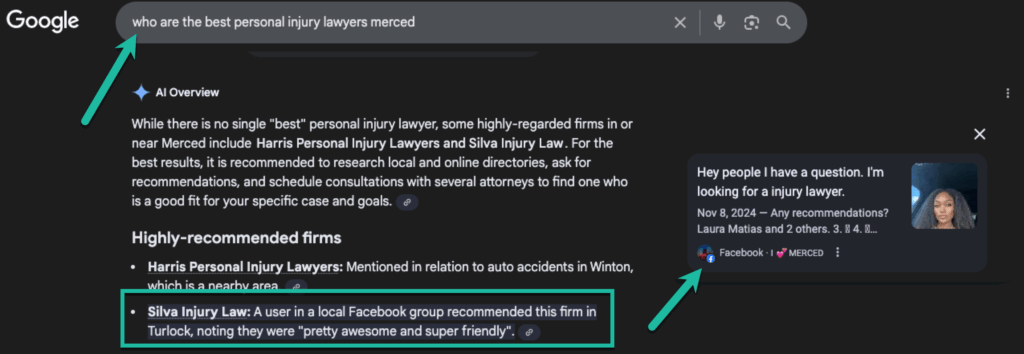
In this case, the AI overview is citing a Facebook post of a user asking a group called “I 💕 MERCED” (the city specified in the search query) for recommendations for an injury lawyer:

You can see that another user commented, “I went with Silva Injury Law…”. The AI then used that to justify citing Silva Injury Law as a recommended firm.
4. Supplement Informational Content with Video Content
Key takeaways from this section
- I see AI tools citing YouTube videos for lots of informational legal search queries.
- Law firms ought to analyze their most impactful informational website content and create videos based on that content.
- This is not a new idea. What is new is that AI search seems to surface a lot more video for informational legal queries than traditional organic search results did, making video creation a greater priority.
One of the overarching themes you are probably picking up on is that in order to be cited in AI search results, it’s really important for your law firm to be in as many digital places as possible.
Now more than ever, your law firm’s content strategy should be rooted in a recognition that publishing to your website alone, in a single format, is likely not going to be good enough to achieve your growth goals.
I suggest creating video content based on your best-performing informational website content. Why? Because videos (especially those hosted on YouTube) are frequently cited in AI overviews, especially for informational searches.
Let’s look at some examples:


Luckily, AI tools themselves have made it easier than ever to create video content. As I stated at the outset, I am not going in-depth on how to execute these tactics here. That’s for a differnt set of posts.
The takeaway for now is that AI search — particularly for informational content — often cites video content, so it is in the best interest of law firms to have a plan for creating and publishing video content.
5. Publish News and FAQ About Niche Topics within Niche Topics
Key takeaways from this section
- I see AI tools citing time-bound news content, niche topics within niche topics, and combinations of both, often for informational legal queries.
- Pre-AI I would have certainly advised that law firms blog about news in their field of law, and that they address niche topics within their niche area of law.
- What’s changed is that now this type of content is far more likely to be surfaced for more broad, evergreen queries, making it a high priority.
I have a client who specializes in noncompete agreements in Texas. Informational keywords are super important for him, and bring in a huge amount of his total traffic and leads.
What I have noticed is that AI tools are often citing niche topics of this already niche topic for his most important information keywords.
For example, below is the AI overview result for the search “are noncompetes enforceable in texas”. You can see that the two links cited in the AI overview aren’t evergreen articles – rather they are time-bound news updates which cover 1) the 2024 ban on the federal noncompete ban and 2) the 2025 change that Texas made to noncompete laws specifically as they relate to physicians (ie. news articles about niche topics within a niche topic)

Pre-AI, I would still have thought it a good idea for law firms to publish news updates related to their area of law. What has changed is that AI systems are surfacing this type of content for search queries that would have traditionally only resulted in high-level evergreen content.
Here’s another example from a different area of law. In this case, the content being cited is not so much news, but it is certainly a niche topics within a niche topic, which is being surfaced for a more broad, evergreen search:

Go forth and put stuff on the internet!
The throughline to all of these tactics is this: It’s more important than ever for your firm to create content in a variety of formats, for a variety of channels.
Hopefully by showing you some of the specific types of content that AI systems tend to rewards, it will help you to take action and start putting more good (and effective) content on the web!
Last updated: