If you run a law firm, you’re probably going to start seeing a new type of marketing report.
Instead of:
“You rank #2 for car accident lawyer.”
You’re going to see:
“Your firm appeared in 37% of ChatGPT prompts this month.”
Or:
“Your AI visibility increased 22%.”
Or:
“We tracked your firm across 500 prompts in ChatGPT, Gemini and Claude.”
It sounds impressive.
And some of this data is genuinely useful.
But I think the legal marketing industry is in danger of making the same mistake with AI that we’ve made with SEO for years.
We’re confusing the thing we can easily measure with the thing we’re actually trying to accomplish.
Your law firm doesn’t make money because ChatGPT mentioned you.
It makes money when the right person finds you, trusts you, contacts you and eventually hires you.
That’s the distinction attorneys need to understand as AI search becomes a bigger part of legal marketing.
Prefer to watch?
Why AI visibility is becoming the new rankings report
Casey walks through this guide in about 12 minutes: what AI visibility tracking measures, why 37% visibility is not 37% market share, and how to connect AI mentions to signed cases.
First: What Is AI Visibility Tracking?
AI visibility tracking is basically the new version of rank tracking. It’s one part of generative engine optimization for law firms, which focuses on how firms can be discovered through AI search.
With traditional SEO, we might track searches like:
- Denver personal injury lawyer
- Denver car accident lawyer
- Denver truck accident attorney
Then we’d record where the law firm ranked in Google.
AI doesn’t work quite like that.
Someone might ask ChatGPT:
“Who are the best car accident lawyers in Denver?”
But they could also ask:
“I was rear-ended in Denver and the insurance company offered me $15,000. What kind of attorney should I call?”
Or:
“My husband suffered a brain injury in a truck accident in Colorado. Which law firms handle serious cases like this?”
These are different prompts, but they may represent similar underlying needs.
AI visibility tools test sets of prompts across systems such as ChatGPT, Gemini and Claude and record which brands appear. Depending on the tool, those sets may include hundreds or thousands of prompts.
This can help us answer questions such as:
- Does ChatGPT recommend our law firm in the scenarios we tested?
- Which competitors appear more frequently?
- Which websites and sources does AI cite?
- Does our firm appear for the types of cases we actually want?
- Is our visibility improving within a consistent set of tests?
Those are valuable questions.
The problem starts when we give the resulting numbers more meaning than they actually have.
Let’s say an agency runs 100 prompts related to car accidents in Denver.
Your law firm appears in 37.
It’s tempting to put this on a report:
AI Visibility: 37%
But what does that actually mean?
It means your law firm appeared in 37% of the tests that particular agency ran under those particular conditions.
It does not necessarily mean:
- 37% of Denver consumers asking AI about car accidents saw your firm.
- Your firm owns 37% of the AI search market.
- Your firm received 37% of potential AI referrals.
- Your firm’s AI marketing generated more cases.
We don’t know that from the test alone.
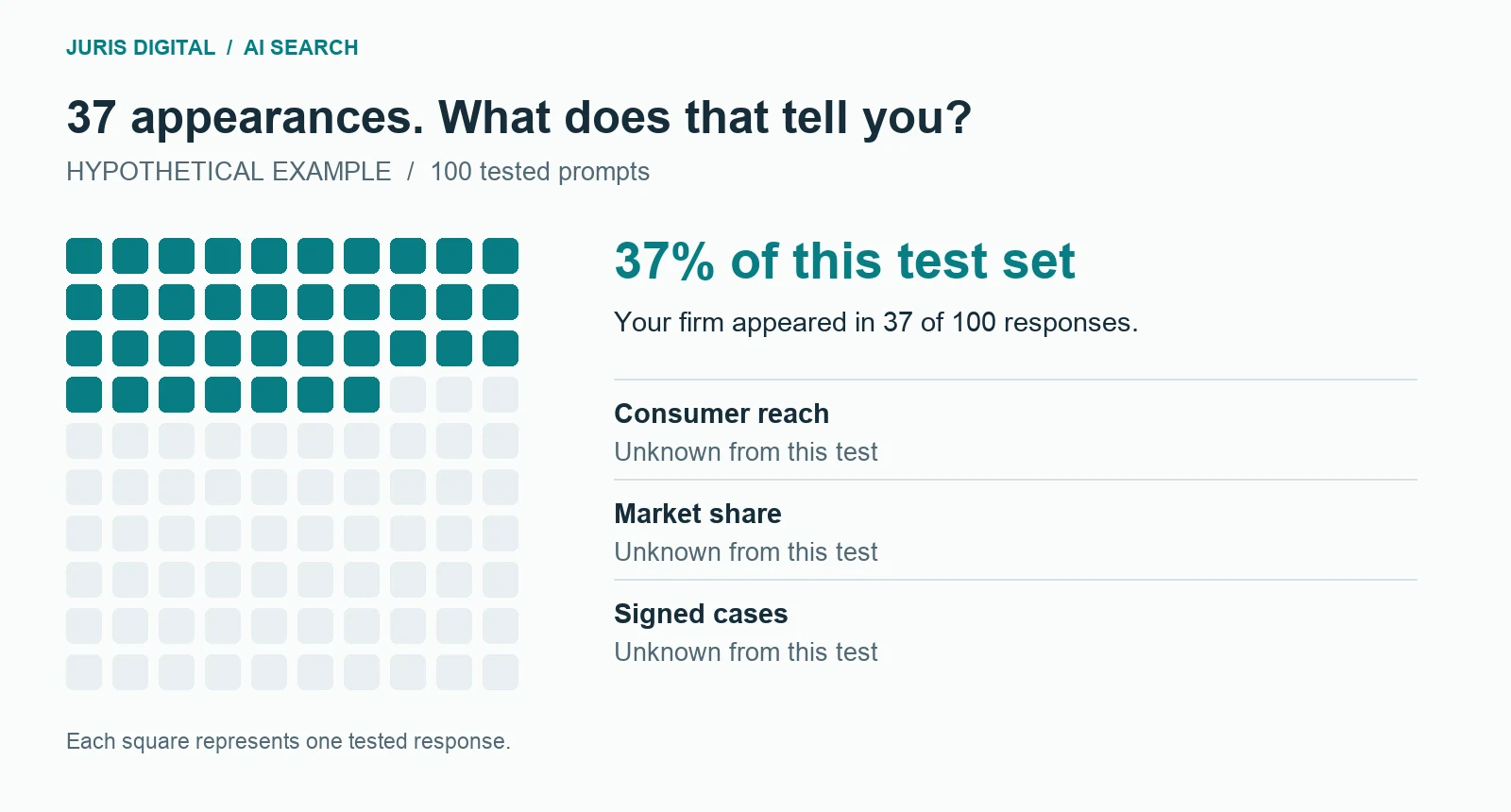
37% of this test set. Your firm appeared in 37 of 100 responses.
- Consumer reach: unknown from this test
- Market share: unknown from this test
- Signed cases: unknown from this test
That’s important because marketers can change the number without necessarily intending to.
Change the prompts and the score changes.
Change the locations and it changes.
Change which practice areas you’re testing and it changes.
Change the AI platform and it changes.
Even asking similar questions repeatedly can produce different answers.
This doesn’t make AI visibility testing useless.
It means we need to call it what it is:
A benchmark.
The Better Question: Why Did AI Recommend That Firm?
This is where AI tracking becomes much more interesting to me.
Imagine you’re a personal injury firm in Oakland.
We test a series of relevant scenarios and discover that ChatGPT frequently recommends three competitors but rarely recommends you.
I’d want to know why.
- What information about those firms is available online?
- What pages does AI cite?
- What independent websites mention them?
- What credentials, cases, attorneys or topics seem associated with those firms?
- Does their website provide substantially better information about the type of case we’re testing?
- Are authoritative third-party sources reinforcing what the law firm says about itself?
- Are there gaps in our client’s digital footprint?
Now we’ve moved beyond:
“Our AI visibility score is 22.”
We’re using AI testing to identify actual marketing opportunities.
That’s much more valuable.
For a concrete example of this kind of source research, see what ChatGPT cited for injury-lawyer searches in 100 U.S. cities. That study is a snapshot of the tested searches, not a measure of consumer market share.
Want More of the Cases That Fit Your Firm?
Let’s discuss where prospective clients find you, what gives them confidence to contact you, and which marketing opportunities deserve your attention.
Think of AI Visibility as a Leading Indicator
This is probably the easiest way for a law firm owner to think about all of this.
AI visibility isn’t necessarily the business outcome.
It’s a potential leading indicator. Whether it predicts useful inquiries is something we need to test.
For example:
AI visibility → discovery → website visit or brand search → inquiry → qualified lead → signed case → revenue
We want to measure as much of that chain as possible.
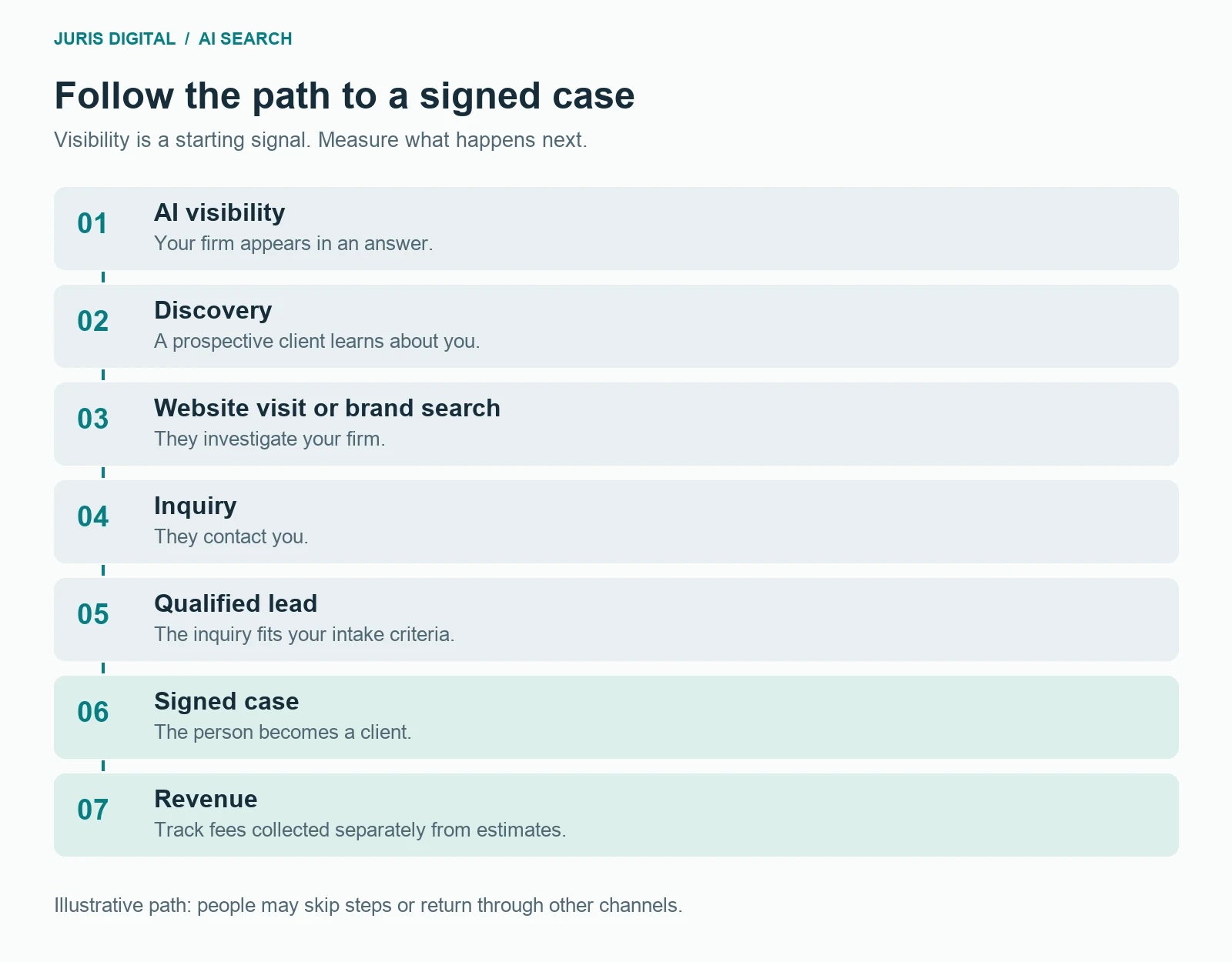
- AI visibilityYour firm appears in an answer.
- DiscoveryA prospective client learns about you.
- Website visit or brand searchThey investigate your firm.
- InquiryThey contact you.
- Qualified leadThe inquiry fits your intake criteria.
- Signed caseThe person becomes a client.
- RevenueTrack fees collected separately from estimates.
That’s very similar to how we should have always approached SEO. Our law firm marketing analytics guide explains how to connect marketing activity to intake and signed cases.
Rankings matter.
Traffic matters.
Leads matter.
But they don’t all have equal value.
If your rankings increase 50% and signed cases decline, I’m not going to tell you your marketing campaign is crushing it.
The same standard should apply to AI.
If your ChatGPT visibility doubles but it doesn’t produce any identifiable increase in qualified opportunities, we should investigate why before declaring victory.
Not Every AI Mention Is Equal
There’s another problem with AI visibility scores.
They can flatten very different outcomes into one number.
Suppose ChatGPT cites an article your firm wrote about California insurance requirements.
That’s good.
Now suppose someone asks:
“Who should I hire for a catastrophic truck accident in San Francisco?”
And ChatGPT specifically recommends your law firm.
That’s probably much more commercially important.
Those shouldn’t necessarily count as the same thing.
At Juris Digital, I think we need to increasingly distinguish between things like:
Citation visibility: AI used the law firm’s website as a source.
Brand visibility: AI mentioned the law firm or attorney.
Recommendation visibility: AI actually presented the firm as an option for someone seeking an attorney.
Qualified recommendation visibility: AI recommended the firm in a situation closely matching the types of cases the firm actually wants.
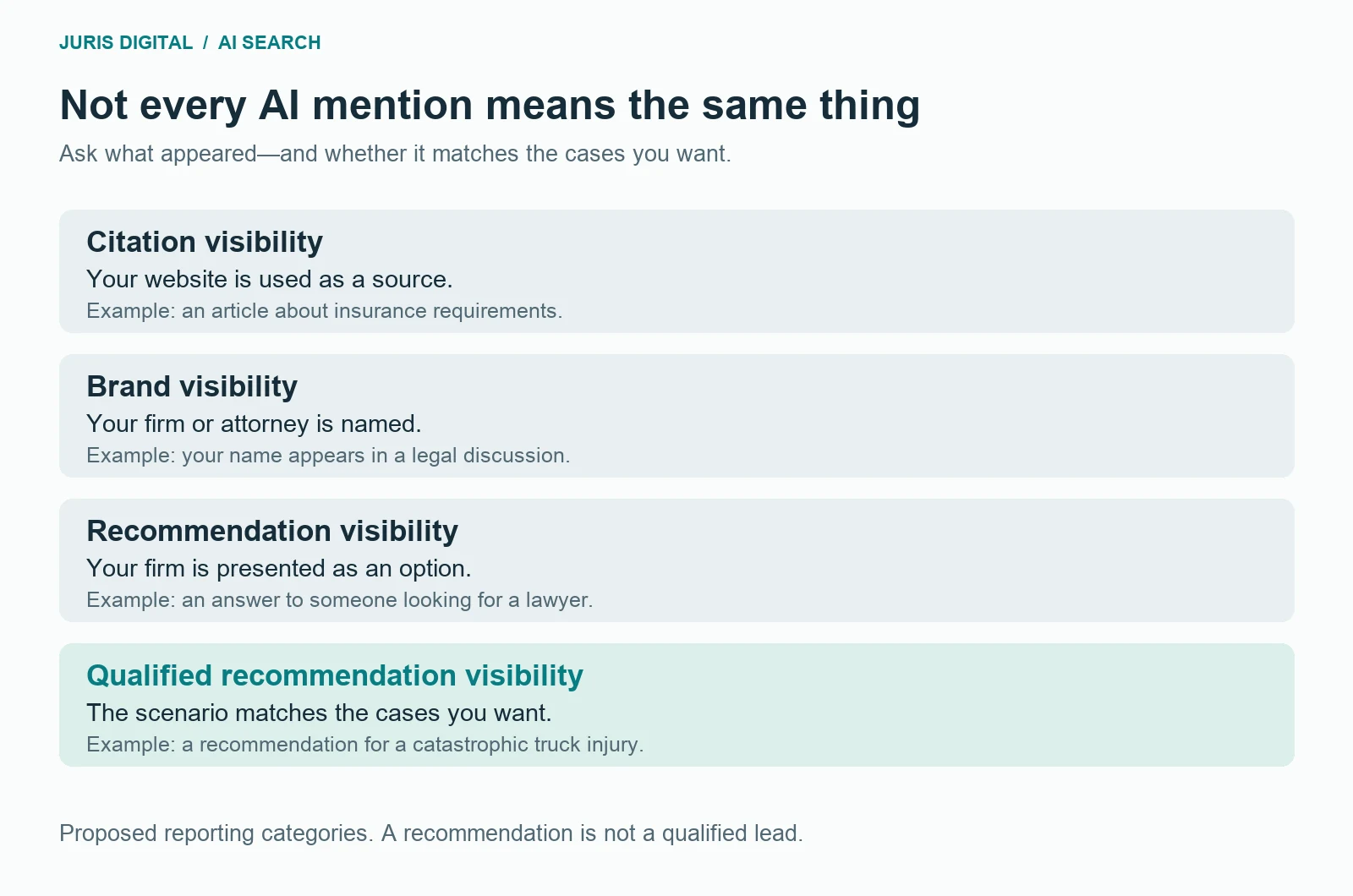
- Citation visibilityYour website is used as a source.
- Brand visibilityYour firm or attorney is named.
- Recommendation visibilityYour firm is presented as an option.
- Qualified recommendation visibilityThe scenario matches the cases you want.
That last one is particularly interesting.
If you’re a personal injury attorney who wants catastrophic injury cases, I care a lot more about whether AI accurately understands that focus than whether it mentions you in a generic discussion about fender benders.
Context matters.
There’s Another Problem: We Can’t See Every AI Search
Traditional keyword research already had limitations.
AI makes those limitations even bigger.
People can have long conversations with AI. Their questions become increasingly specific. They provide personal context. They ask follow-up questions.
The conditions behind an answer can matter, too. For example, OpenAI explains that ChatGPT search can use location information and relevant saved memories when forming search queries.
A prompt-testing dashboard does not give us a complete record of every consumer conversation across every AI platform.
That means anyone telling a law firm:
“We know exactly what percentage of ChatGPT searches you appear in.”
should be able to explain exactly how they know that.
Usually what they really mean is:
“You appeared in X% of the prompts we tested.”
That’s still useful.
It’s simply a different claim.
So Should Law Firms Track ChatGPT Rankings?
Yes.
Absolutely.
We are doing it.
By tracking, I mean measuring appearances across a defined set of tests—not treating the order of firms in an AI answer as a stable ranking.
I just think we need to do it responsibly.
For important markets and practice areas, establish a consistent benchmark.
Run the same commercially relevant scenarios over time. Test across major AI platforms where appropriate. Record which firms appear and which sources get cited. Look at competitors. Look for patterns.
Keep a record of the test conditions, too: the exact prompts, platform and model where known, date, search settings, location and conversation context. Repeat tests where useful, and record platform changes that could affect comparisons. The same principle applies to building trustworthy law firm marketing reports: keep the definitions and source records behind the numbers.
Then use additional research prompts to investigate why those patterns may be happening. An AI system’s explanation of its own recommendation is a research lead; check it against the cited pages and other evidence.
The important part is keeping those two jobs separate.
One set of tests measures change. Another set helps us investigate opportunities.
If you constantly change the questions in your benchmark, it’s much harder to know whether the law firm’s visibility actually changed or whether your test changed.
Then Connect AI Visibility to Actual Cases
This is the part I think will ultimately separate useful reporting on generative engine optimization, or GEO, from vanity reporting.
We need to move further down the funnel.
Where possible, law firms should be asking:
- Did someone actually come to our website from an AI platform?
- Did they contact us?
- Was it a qualified lead?
- Did the firm sign the case?
- What was that case worth?
Keep estimated case value separate from fees actually collected. Those are different business measures, too.
Attribution won’t always be perfect.
Someone might discover your firm in ChatGPT and Google your name two days later.
Another person might see your firm repeatedly across Google, YouTube, LinkedIn and ChatGPT before finally calling.
That’s marketing.
It has always been messy.
Your marketing and intake teams can combine identifiable referral traffic, inquiry records and a simple question about how the person found you. Keep confirmed AI referrals separate from suspected influence, and don’t treat missing attribution as proof that AI played no role. Our paid-media attribution framework explains this distinction for advertising: observed interactions and self-reported influence should remain separate. That record-keeping discipline is useful here, too.
But imperfect attribution isn’t an excuse to stop at the easiest metric.
We should keep trying to get closer to the business outcome.
AI Search Doesn’t Change the Fundamental Job of Marketing
This is probably my biggest takeaway.
AI search is new.
The underlying marketing principle isn’t.
People tend to hire businesses they know and trust.
Your job is to build enough evidence across the internet that when someone, Google or an AI system investigates your law firm, there is a compelling reason to believe you’re a credible choice.
That means continuing to invest in things like:
- A genuinely useful website
- Strong practice-area and local content
- Attorney expertise
- Original research and insights
- Reviews and reputation
- Digital PR
- Authoritative mentions
- Community involvement
- Video
- Helpful resources
- Technical SEO
- Brand building
There isn’t a magic piece of “GEO code” that suddenly makes ChatGPT love your law firm.
Technical access matters, but it isn’t a guarantee. OpenAI’s guidance on inclusion in search says sites should allow its search crawler and that placement is not guaranteed.
Our job is to make sure the right information and evidence about the law firm exists, is clear, is consistent and can be discovered. For practical next steps, see eight ways law firms can improve AI search visibility.
Don’t Let AI Visibility Become the New Rankings Report
This is the part I hope attorneys remember.
For years, the SEO industry trained clients to celebrate rankings.
Your agency could walk into a meeting with a beautiful report showing 200 keywords moving up and to the right.
Meanwhile, the managing partner was thinking:
“That’s great. Where are my cases?”
We shouldn’t repeat that mistake.
A dashboard saying:
ChatGPT Visibility ↑ 42%
might look great.
But it doesn’t make payroll.
It doesn’t pay for your next associate.
It doesn’t fund your next office.
And it doesn’t grow the firm unless that visibility eventually influences real people.
AI visibility matters.
We should measure it. We should study it. We should absolutely be working to improve it.
But it is a signal, not the finish line.
At Juris Digital, our goal isn’t simply to make law firms visible in AI.
It’s to understand how people discover attorneys across Google, ChatGPT and the rest of the modern search ecosystem, then help our clients turn that visibility into qualified opportunities and signed cases.
Because whether someone starts their search in Google, ChatGPT, Gemini, Claude or whatever comes next, the fundamental goal hasn’t changed:
Get the right person to know you.
Give them a reason to trust you.
Make it easy for them to contact you.
And measure whether that marketing actually helped grow the firm.
Everything else is a metric along the way.
Will the Right Clients Find Your Firm—and Choose You?
You want more of the cases that fit your firm. Let’s discuss how prospective clients discover you across Google and AI search, what gives them confidence to contact you, and how to measure whether your marketing produces qualified inquiries and signed cases.
Last updated: