
If your firm takes injury cases, you probably want to know whether ChatGPT names you when someone asks for a lawyer nearby. I would start with a second question: What pages is the answer relying on? A mention beside an outdated directory listing can create a different first impression from a link to your own, accurate practice page.
We ran 1,000 city-specific lawyer searches through DataForSEO's ChatGPT LLM Scraper on October 1, 2026. The prompts covered the 100 largest U.S. cities, with five personal injury phrases and five car accident phrases in each. We counted the pages ChatGPT cited in the visible answers, then checked how the sources changed by case type and city.
The immediate lesson for a firm owner is practical. Do not decide which profiles or pages deserve attention from a national list alone. Check the sources that appear for the matters you want in the markets you serve, then ask whether those pages tell the truth about your lawyers, offices, and work.
The sources changed with the case type
Justia appeared in 227 of the 500 personal injury answers, but only 12 of the 500 car accident answers. Avvo appeared in 120 personal injury answers and 207 car accident answers. Lawyers.com was cited in 71 and 151, respectively. The same cities were tested in both groups.
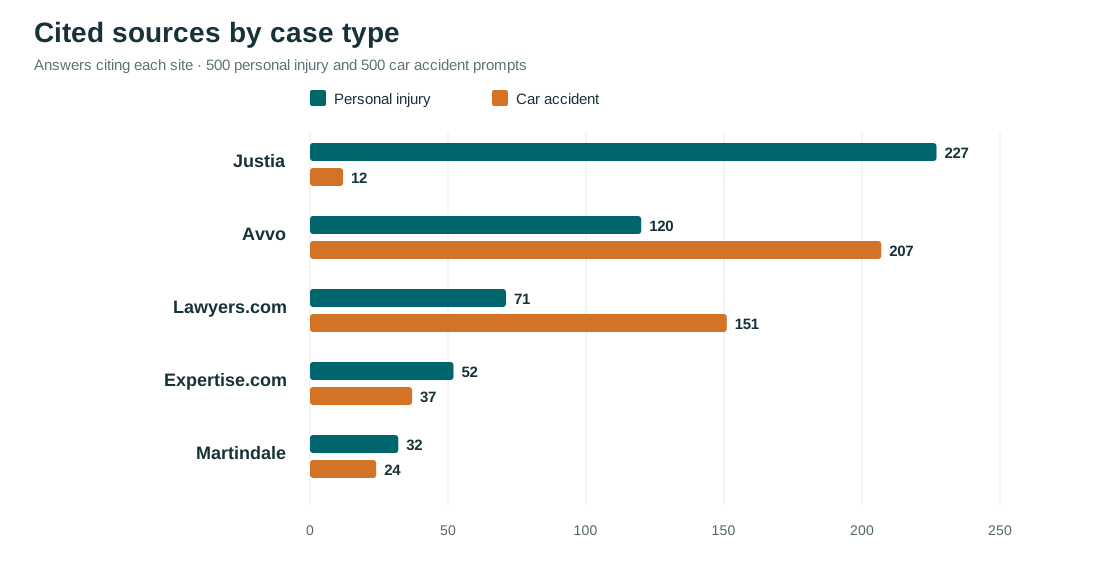
| Site | Personal injury answers | Car accident answers |
|---|---|---|
| Justia | 227 / 500 | 12 / 500 |
| Avvo | 120 / 500 | 207 / 500 |
| Lawyers.com | 71 / 500 | 151 / 500 |
| Expertise.com | 52 / 500 | 37 / 500 |
| Martindale | 32 / 500 | 24 / 500 |
View the source-data screenshot
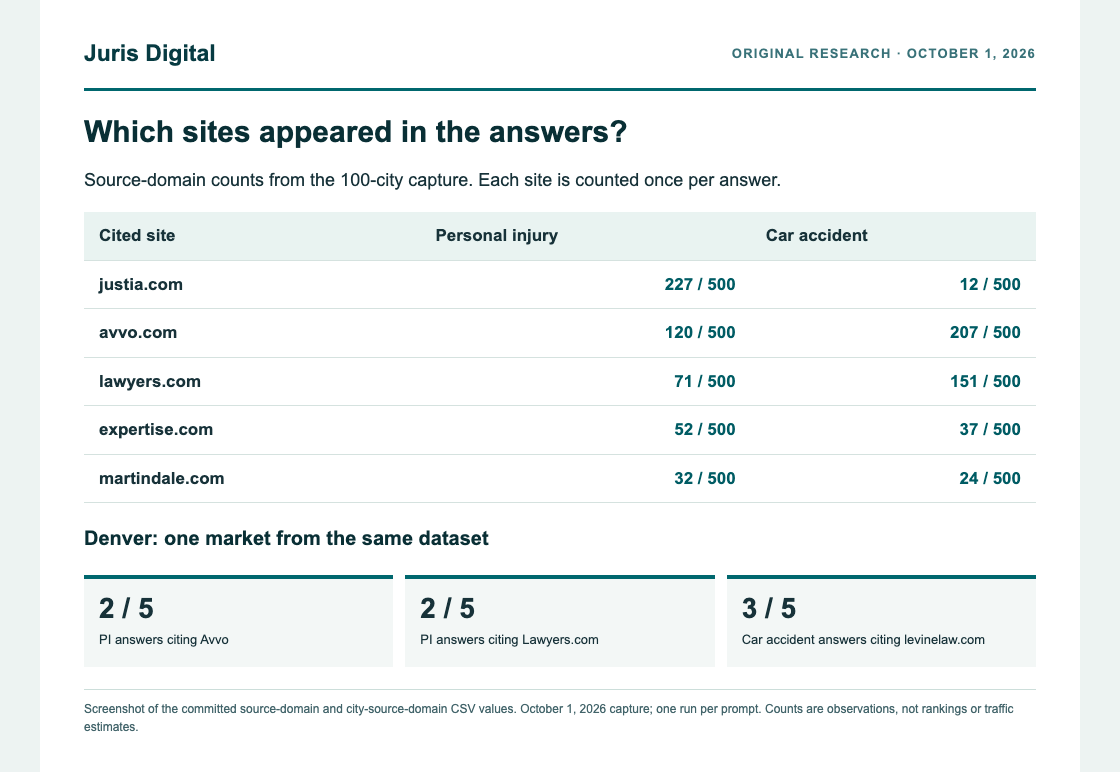
These are citation counts, not law firm rankings. A cited directory page can list several attorneys. A cited firm website can describe one practice area or several. We did not count every retrieved search result, only a URL the final answer actually cited. The underlying cited URL file lets you inspect those pages and the prompts that produced them.
For firms, that distinction matters. Paying for a profile does not follow from this result. First find out which pages appeared, whether your firm was named, and whether the facts on those pages are accurate. Our guide to legal directories and local citations covers the ongoing profile work.
Denver shows why the city view matters
In Denver, two of five personal injury answers cited Avvo and two cited Lawyers.com. None cited Justia, although Justia led the national personal injury count. Three of five Denver car accident answers cited Levine Law's website. That does not make Levine Law the national car accident leader. It shows why a local source review can be more useful than a national top-ten list.
Here are two of the archived Denver answers behind those counts. These are screenshots of the DataForSEO capture fields, including the prompt, an answer excerpt, and the cited pages. They are not screenshots of the ChatGPT interface, and we have not verified every firm description in the answers.
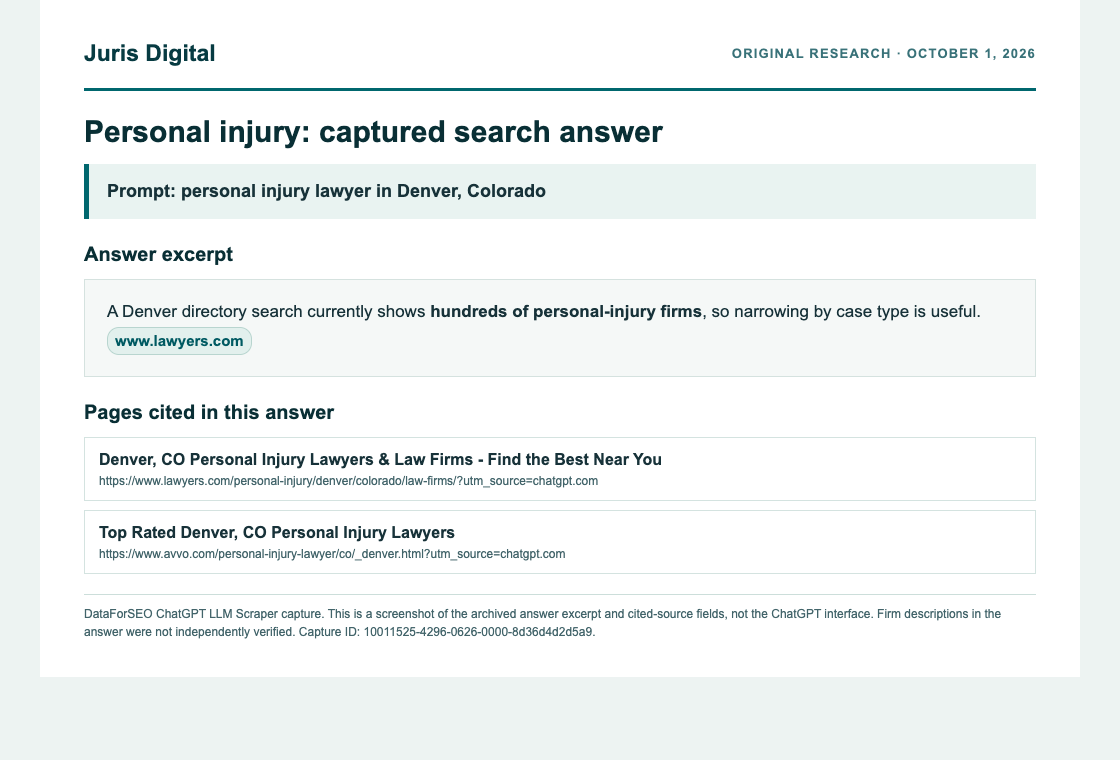
“personal injury lawyer in Denver, Colorado.” Cited Lawyers.com and Avvo. Open full image ↗
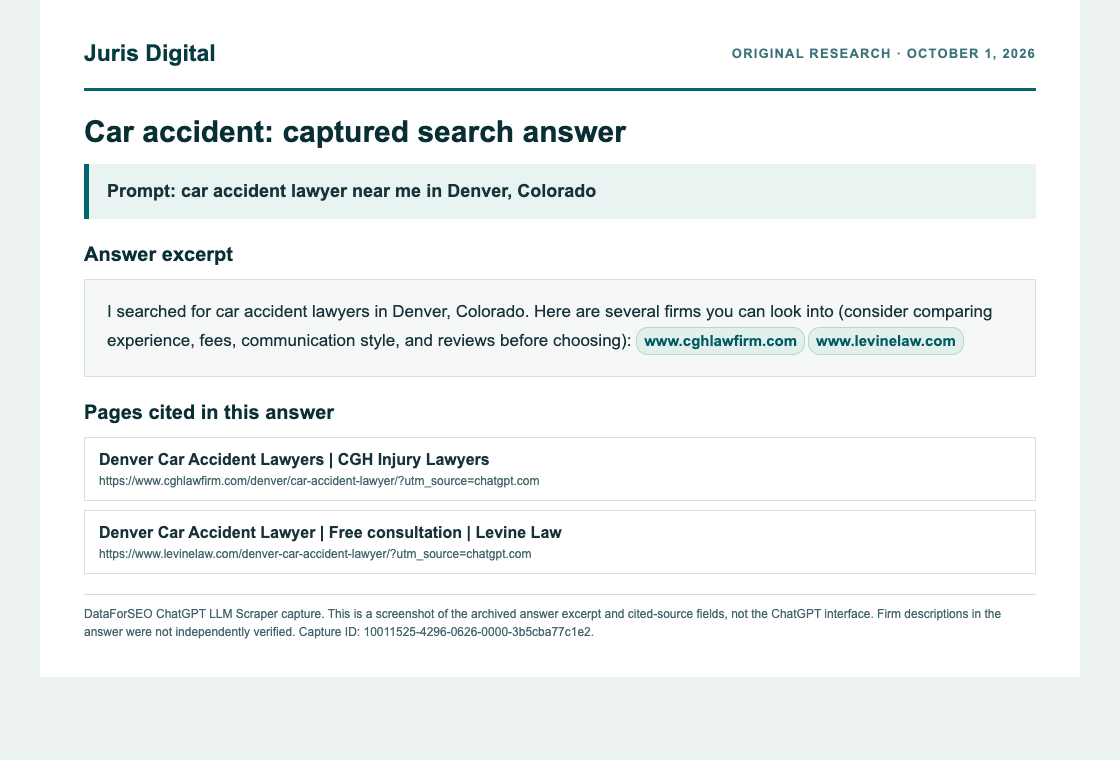
“car accident lawyer near me in Denver, Colorado.” Cited two firm websites. Open full image ↗
Each Denver phrase was run once. Those small counts can change in a repeat capture. Use the 100-city source table to find your market, then open the cited URLs before assigning work. The table shows observed sources, not a guarantee that the same pages will appear for a real prospective client.
A useful audit starts with the cases you want
A firm that wants more serious crash matters should not treat every injury search as equally important. Choose the case types and service areas that fit the firm, then review the matching answers. Have someone on the team record four things:
- Was the firm named? Note the exact wording, not just a yes or no.
- Which page was cited? Separate your own website, a directory profile, a bar page, and a competitor's site.
- Are the facts right? Check attorney names, office location, practice focus, phone number, and any experience or result claims.
- What happened after the inquiry? Track qualified calls and signed matters in intake. An answer citation is an early observation, not a client.
If your firm is absent, this study cannot tell you why. It does give you a set of pages to inspect. Correct errors you control, improve the pages that explain your actual work, and repeat the same prompts over time. The broader guide to earning ChatGPT and Perplexity citations covers the content and source strategy behind that work.
How we ran the study
We selected the 100 markets from the U.S. Census Bureau's Vintage 2025 city population ranking. Each prompt named the city and full state. The five personal injury phrases were “personal injury lawyer near me,” “personal injury attorney near me,” “personal injury lawyer,” “personal injury attorney,” and “motorcycle personal injury lawyer near me.” The car accident phrases were “car accident lawyers,” “car crash lawyer,” “car accident lawyer near me,” “car accident attorney near me,” and “auto accident lawyer near me.” We appended “in [city], [state]” to each.
The phrase selection used DataForSEO's U.S. Google keyword estimates. Those figures helped us choose familiar search language. They are Google estimates, not ChatGPT query volumes. We did not add similar phrases together to claim total demand.
All 1,000 captures used DataForSEO's ChatGPT LLM Scraper with its U.S. location setting, English, and web search forced on. The answers reported model gpt-5-6. We recorded provider-reported cited sources separately from retrieved results, and every recorded citation URL appeared in the visible answer. One answer had no citation.
The city was in the wording, but the U.S. setting did not simulate a device or IP in each city. We ran every prompt once on October 1, 2026. Answers may differ with another run, user, or date. We did not verify every generated firm description or measure calls, consultations, or signed cases. A cited link does not prove the linked page caused the recommendation.
For readers who want to check the work, download the city and source counts or the URL-level citation records. The first file is easier to scan; the second provides the cited page and prompt behind each record.
What I would do next
Pick one market and one matter type. Review the five answers, open each cited page, and make a short list of incorrect facts and missing information. Put the fixes you control into your website and profiles. Then run the same question set again and compare the answers without treating a single mention as a business outcome.
For a wider plan, read our guide to GEO for law firms. If you are deciding whether to hire help, the AI search visibility buyer's guide explains what to ask. The important decision for your firm is which source gaps affect the clients and cases you actually want.
Last updated: