I built a browser game where you earn points by reducing an injured family’s insurance payout.
It’s called Play the Adjuster. You sit behind the desk of a fictional insurance adjuster, work through five decisions, and watch your bonus grow as the family’s payout shrinks.
The more successful you become according to the game’s scoreboard, the harder things get for the people on the other side of the claim.
That tension is the reason we built it.

At Juris Digital, we spend a lot of time thinking about how websites communicate. For this experiment, I wanted to explore what happens when we give visitors a role in the story. Let them make the decisions. Let them see the consequences. Then give them a reason to think about what they just did.
Play the Adjuster takes about three minutes. The question it raises should stay with you longer.
You begin with the Miller family’s claim for $120,000. Alex has been injured in a collision. Medical bills are accumulating, work has been missed, and the family wants to move forward.
Your fictional employer has a different priority: reduce the payout.
Five documents arrive on your desk:
- The opening offer. Move a slider to decide how much of the claim you’ll keep on the table.
- The paperwork. Route the family’s records into a tray. Accept the complete file or send them through another round of requests.
- The medical review. Check or uncheck blocks of recommended treatment.
- The lost wages. Use the payroll calendar to decide which periods of missed work you’ll recognize.
- The final settlement. Choose the final amount, then hold to sign.
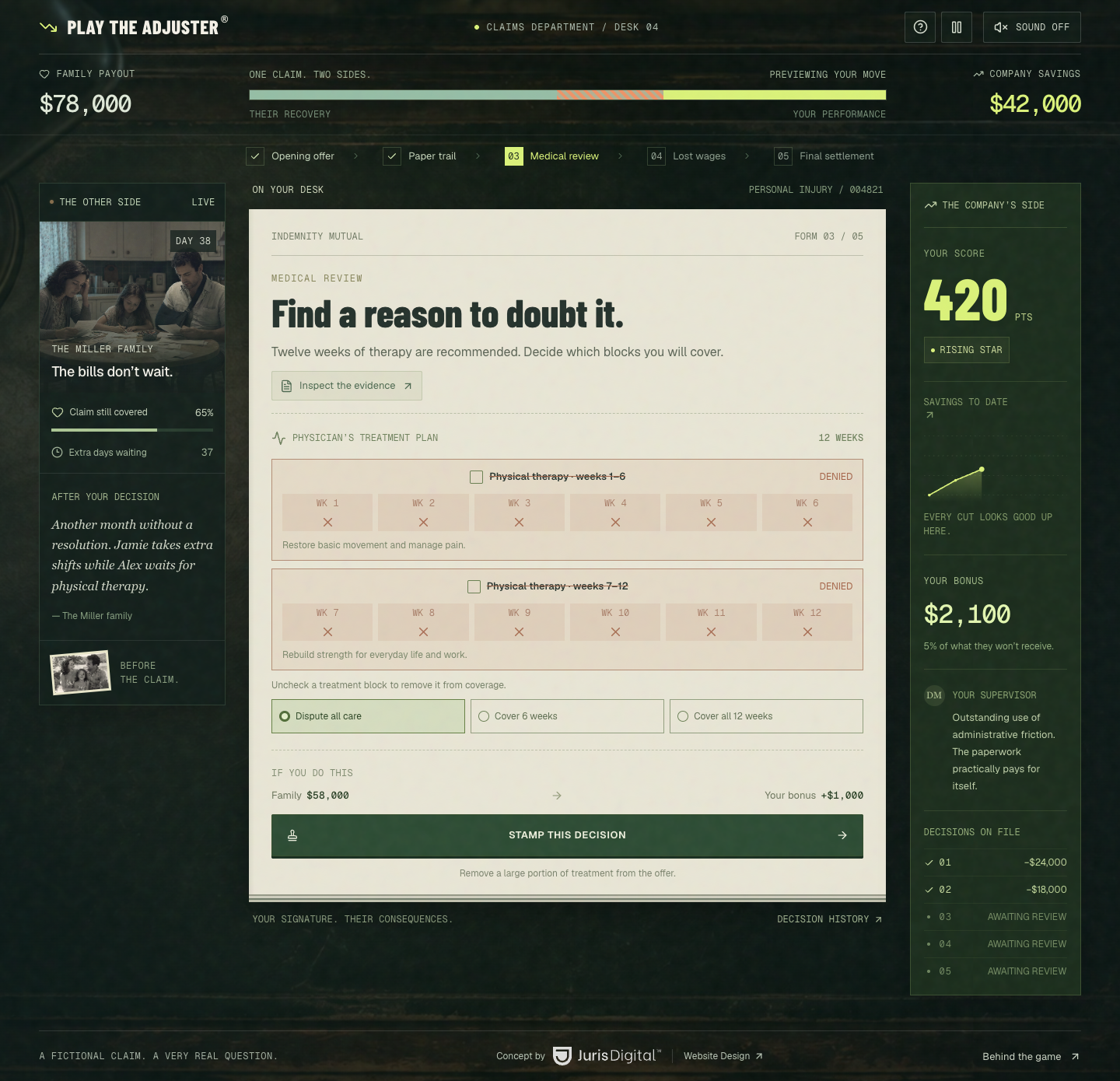
Each decision changes the numbers. The family’s payout, company savings, your score, and the accumulated waiting time respond to what you do.
Take the largest reduction in every round and the original $120,000 claim becomes a $24,000 payout. You collect a fictional $4,800 bonus. The family has accumulated 86 days of waiting.
You can also protect every dollar. The game allows you to accept the documentation, follow the physician’s recommendation, recognize the lost wages, and settle without another cut.
You’ll finish with zero points and no bonus.
I wanted that choice to remain available. The player has agency. The scoreboard gives them a reason to question what it rewards.
The people, insurer, claim figures, and bonus formula are fictional. The family imagery is AI-generated. These are deliberately constructed elements of a satirical story.
We put particular attention into how the decisions feel.
You handle paperwork. You remove treatment from a schedule. You stamp a decision and sign a settlement. The family scene changes as the claim progresses, while the financial displays show what your choices mean for each side.
Those interactions make the player’s role concrete. Clicking through a form and watching a number change can feel routine. Seeing that change alongside a family waiting for treatment gives the same action a different weight.
The motion has a job, too. It helps you follow the money and connect your decision to its result. Sound adds to the atmosphere, and visitors can control sound and pause motion.
For me, this is where the experiment connects to law firm website design.
A visitor may arrive at a law firm’s website trying to understand an unfamiliar process. They may have questions they don’t yet know how to ask. The format we choose can help them work through those questions.
An interactive timeline could let someone explore the stages of a case. A guided document checklist could help them prepare for a conversation. A carefully written scenario could show how different circumstances lead to different questions.
Each experience needs a clear purpose. What should the visitor understand when they finish? What should they be able to do next? The answers should shape the design, the writing, and the interaction.
That’s the thinking I want us to keep bringing to our law firm website design work. Start with something a person needs to understand, then build an experience that helps them understand it.
Play the Adjuster ends with the line that carries its satirical argument:
“Your insurance company is playing this game. Now you know the rules.”
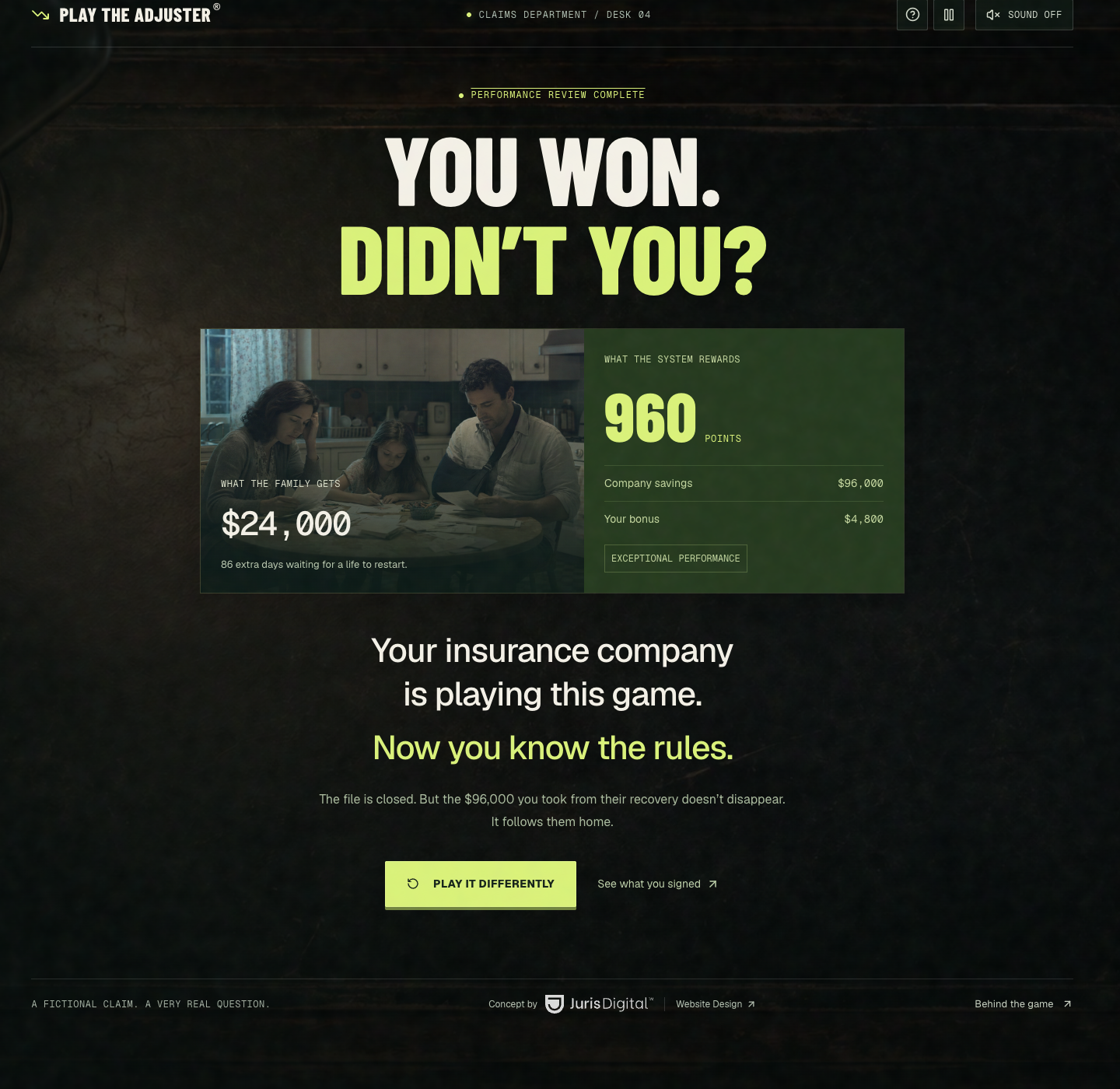
By that point, you’ve made the choices yourself. You’ve seen the score rise, the payout change, and the family live with the result.
Take your seat and play Play the Adjuster.
Then play it again with different decisions. I’d like to know which choice made you hesitate.
Last updated: