 Yelp. Whether you love them or hate them you’ve at least heard of them, and you’ve likely used their website or app to find a good sushi joint in your neighborhood.
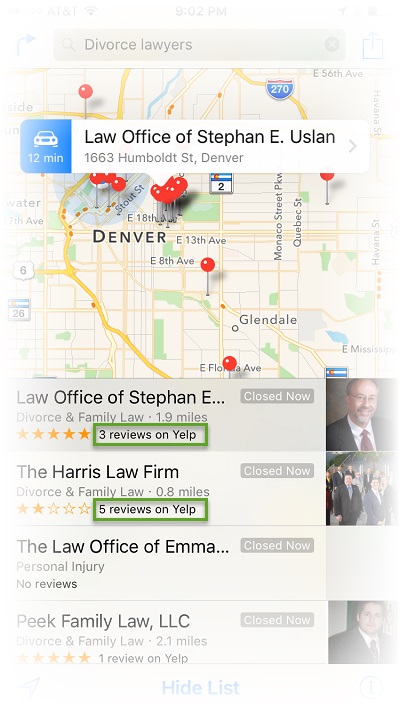
There have been over 10mm downloads of the Yelp app in the Google Play store and it’s the 32nd most popular website in America according to Alexa.com. To top it off, Yelp’s data is relied on heavily by Apple Maps (see image to the right).
Between it’s massive app user base, website traffic, and integration with Apple Maps, Yelp is a compelling advertising platform. It’s no wonder that law firms have begun to test whether Yelp Advertisements can be an effective way to attract new clients.
For the remainder of this post we will explore the question, should law firms expect a positive return on a Yelp advertising investment?
Specifically, we’ll look at the fundamental features and functionality of Yelp’s ad products, and we’ll dive into two real world case studies from lawyers we’ve talked to who’ve advertised on Yelp. Let’s go!
Quick compliance note before we get into mechanics. Paying Yelp for ad placement is advertising, not a prohibited recommendation. ABA Model Rule 7.2 lets lawyers pay for online directory listings and internet ads, as long as the platform isn’t endorsing or vouching for you. Yelp doesn’t, so the platform’s fine to pay. Your state may add disclosure or recordkeeping requirements on top, so check your own bar’s version of the rule.
Where are Yelp Ads Displayed?
Ads are displayed across Yelp’s platforms; desktop website, mobile website, and mobile app. With regards to placement within their platform, Yelp explains:
“Yelp Ads appear in a variety of places including on relevant search result pages and competitor business pages.” – Yelp Advertising
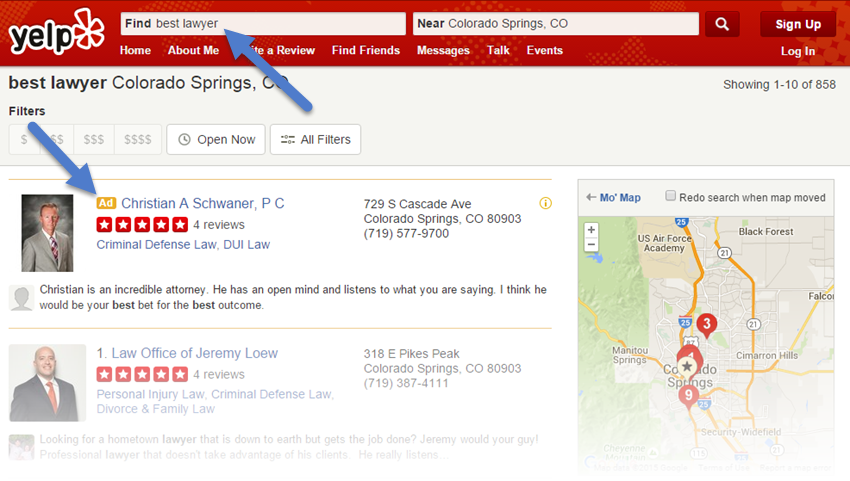
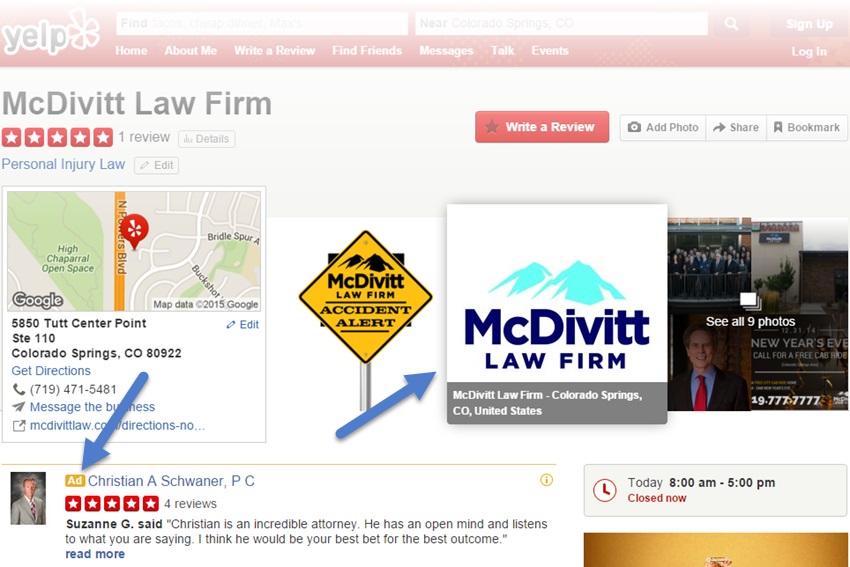
In a nutshell, if you buy ad space on Yelp, your ad will show in one of these two places:
1. On search result pages:
2. On competitor’s pages:
Does Yelp’s Ad Platform Offer User Targeting Options?
Nope. The Yelp advertising platform does not allow you to target your ads to users based on specific relevancy indicators, such as keyword search or demographics. The process for signing up is pretty simple though. You sign into your account, select your monthly budget, and you’re done. This is an easy process but is it effective?

I’m of the opinion Yelp’s inability to allow marketers to target a more relevant audience makes their advertising platform less effective overall. Any marketer worth her salt will tell you that the ability to target a relevant audience is crucial to effective marketing.
For example, if Sally logs on to Yelp to search for a lawyer to help her with a child custody matter, and she instead is served ads for lawyers who primarily handle personal injury, she is not likely to engage with the ad.
The take away here is that because Yelp does not offer any sort of targeting functionality, it’s impossible to know whether your ad is reaching a relevant audience more often than not.
Now that we’ve established the basics of Yelp’s ad platform, let’s look a couple of case studies and feedback from actual law firms who’ve advertised on Yelp.
Quick note on what this actually costs. Yelp uses a cost-per-click (CPC) model. You only pay when someone clicks your ad. Most industries see clicks at $3 to $6. Legal is one of the priciest categories on any ad platform, and attorney clicks usually land in the $10 to $30+ range depending on the market. Realistic monthly budgets for law firms run $300 on the low end up to $1,500 or more. On contracts: Yelp used to lock advertisers into 12-month terms through their sales reps, and they still sell annual deals with early termination fees. The good news is the self-serve option (the one you sign up for online without talking to a rep) has no commitment period. You can end the campaign from inside your business account whenever you want, effective the same day. If a Yelp rep is pushing a 12-month term, that’s the one to ask about instead.
Law Firm Ads on Yelp: Case Study #1
As legal marketers we are constantly testing and trying new advertising methods. High keyword rankings and lots of free Google search traffic is cool, but the reality is that we care most about helping our clients sign more cases.
If after testing we find that a certain advertising platform or channel is ineffective, we abandon it. If we find another that is particularly effective, we invest heavily in it. In this example, we were testing Yelp Ads for a Denver based attorney who handles personal injury and traffic cases.
We decided to start off small with a $250 budget. Typically 1 out of every 5 contacts might turn into a case for this attorney so we are shooting to get at least 5 contacts (not clicks) a month. These clicks tend to end up around $10 per click in Denver. Now let’s look at the results.
Overview
- Listing URL: http://www.yelp.com/biz/the-law-offices-of-sandomire-and-schwartz-denver
- # of Reviews: 0
- Star Rating: N/A
- Monthly Budget: $250
- Average Cost-Per-Click: $10
Month 1 Numbers
- Impressions (# of times the ad was actually displayed to a user): 139
- Ad Clicks: 0
- Clicks to Website: 0
- Calls: 0
- Cases Signed: 0
Month 2 Numbers
- Impressions: 2,011
- Ad Clicks: 12
- Clicks to Website: 0
- Calls: 0
- Cases Signed: 0

What does This Mean?
This is a small sample size but the numbers don’t look promising. Considering the issues that I pointed out above, specifically in an industry that has a general categorization and then sub categories (practice areas), there are some flaws in the system. I plan on keeping this test running for a bit longer and adding more data but so far it’s not helping sign cases.
Another flaw of course is that this is a pay per click product which means I will always pay for these clicks. Some months could potentially be better than others.
For this particular client I am going to suggest that they focus more on building up their Yelp reviews, to see whether that increases click through rates (CTR) and conversions.
Quick aside on where Yelp sits next to Google’s paid options, which are what most firms test first. Google Search Ads let you target by keyword (personal injury attorney, divorce lawyer, etc.) and by city, which is the relevance Yelp’s ads still don’t really offer. Google Local Services Ads (LSAs) go a step further. You pay per lead instead of per click. Your ad sits at the very top of local search. And the Google Screened badge gives you a trust signal Yelp can’t match for legal. For most firms we work with, LSAs are the first paid dollar, then Google Search ads. Yelp ads, if at all, come much later.
Law Firm Ads on Yelp: Case Study #2
This case study is from Jared Staver from the Staver Law Group.
Jared reached out to me while I was searching for more info on attorneys who have had actual experience using Yelp to advertise their law firm. He’s been advertising with Yelp and considers the results lack luster.
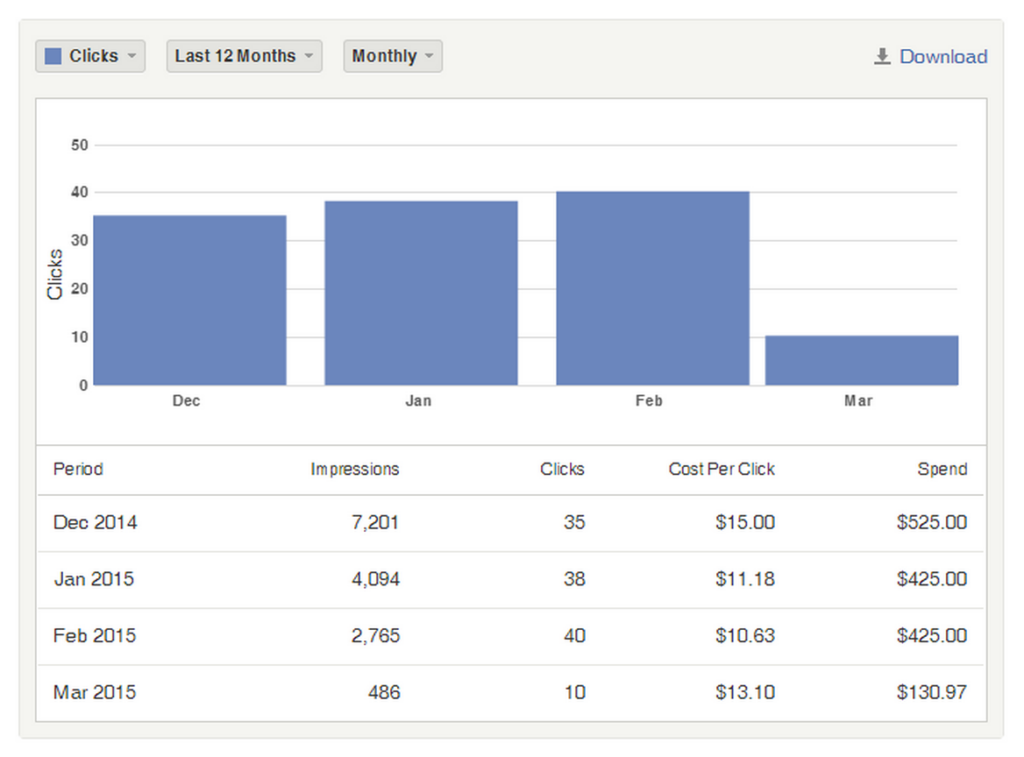
The Staver Law Group is a Chicago based law firm with a monthly budget of $500 per month for Yelp paid clicks. Because the firm places a premium on the ability to track where their leads come from (which all businesses should), they use tracking phone numbers, live chats, and contact forms to determine the lead conversion source.
Overview
-
- Listing URL: http://www.yelp.com/biz/staver-law-group-pc-chicago
- # of Reviews: 2
- Star Rating: 5
- Monthly Budget: $500
- Average Cost Per Click: $12.50
Are These Yelp Ads Effective for the Staver Law Group?
“We are tracking goal conversion for phone calls, live chats, contact forms and emails and for last quarter there were 7 conversions from Yelp. This brings the cost per conversion to $196 per contact. This number alone isn’t too bad for a personal injury lawyer, but it’s not too good either. The appeal of being at a $12.50 per click costs diminishes quite a bit when the conversion rate is only 6%. What this means is that these aren’t really people needing help in our area of practice viewing our profile on Yelp. Of the 7 contacts we’ve received from Yelp, none of them have been cases we would handle. Even though our paid ads with Yelp are only showing up for personal injury, so far it seems people are calling for other reasons or to solicit the firm.” – Jared Staver
Jared seems to agree with my point that Yelp provide a lower conversion rate because of the inability to target relevant users. More importantly, he provides another case study of a monthly budget that did not convert clicks into clients.
A quick note on conversion rates more broadly. Across the firms we’ve tracked running Yelp ads, click-to-contact rates run anywhere from 2% to 8%. (Click-to-contact is the share of ad clicks that actually pick up the phone or fill out a form.) Profile strength explains most of the spread. A page with no reviews like Case Study #1 sits at the bottom. A page with strong reviews does a little better. But ‘contact’ and ‘signed case’ are two very different numbers, and this article is about the second one. Even at the higher end of the contact range, the lead quality on Yelp isn’t there for most legal practice areas.
Feedback From Another Law Firm
“We advertised on Yelp for a short period of time hoping to generate leads for our firm before pulling out. The traffic quality was not great and we were able to get more qualified leads from Google and Bing/Yahoo! PPC efforts on the paid side. When people are searching for a lawyer, they’re more likely to do an organic search on Google as opposed to going to Yelp. We were able to gauge the traffic and conversion data in our analytics before making the decision quickly to move in another direction.” – Christian Denmon from DemonLaw.com
One question that comes up every time I talk to a firm about Yelp: does paying for ads keep your good reviews from getting filtered? Yelp’s official answer is no, and every regulator who’s looked at how their filter works has reached the same conclusion. Our experience matches that. The reason the suspicion sticks around is that Yelp’s filter is aggressive about which reviews it shows. And it makes its calls based on the reviewer’s history and posting patterns, not on whether the business pays. First-time reviewers (who are exactly the people most firms ask) get filtered the hardest. Paying Yelp doesn’t fix that. Building up reviews from active Yelp users over time is what does.
Do Yelp Ad’s Convert & Help Law Firms Sign Cases?
From the data I have the answer is clearly a no talking to these attorneys and other attorneys. As I have written about before, I see Yelp helping your law firm in three different ways, none of which include paid advertising.
- Optimize your Yelp listing to boost local SEO for your law firm.
- Gain customer reviews for reputation management. Potential clients are going to research your name. Make sure you have great reviews and hopefully they keep coming.
- Barnacle SEO. You can get your Yelp listing to rank in Google for attorney based organic keywords.
If your firm’s Yelp listing is optimized and you have strong reviews you can possibly get some conversions that way. But we suggest focusing on investing in law firm SEO or PPC marketing to get more volume and better results.
Do you have a similar or different experience? I would love to hear from you. Please leave a comment below.
Last updated: