Previously on this blog we published the results of a study which found that Google returns localized search results for non-local informational keywords 81% of the time.
Based on that study, we recently ran a test on one of our client’s sites to see if we could force Google to show a localized search result for a keyword that was previously not triggering localized results.
The Test: Can you force Google to show localized results for a keyword that doesn’t currently trigger localized results?
On May 17 2021, we conducted a search for “do I need a personal injury lawyer” from Evansville Indiana. At that time, none of the traditional organic results on page 1 of Google were localized. However, when we searched the same keyword from Chicago, we saw that 3 of the page 1 results were localized to Chicago law firms. This told us that Google wants to show localized results for this keyword, but likely wasn’t due to a lack of suitable content that was specific to Evansville Indiana.
We wanted to see if we could force Google to show a localized search result from searches conducted in Evansville by optimizing (localizing) an existing piece of content.
We have a client who is located in Evansville, Indiana – Gerling Law – for whom we had previously published a post optimized for our target keyword: https://www.gerlinglaw.com/do-i-need-a-personal-injury-lawyer/.
As of May 17th, this post did not rank on page 1 of Google for the keyword “do I need a personal injury lawyer” when searched from Evansville.
Quick note on how we ran that check, since it’s the whole basis for the test. We pulled the SERP for our target keyword from Evansville and from Chicago using a location-aware rank tracker. Then we compared the two result sets side by side. The Chicago set had localized law firm pages. The Evansville set didn’t. That gap is the signal. It tells you Google is ready to localize for this keyword and is just waiting on a page that fits.
So, we made the following changes to the post:
- We added “Indiana” to the page title, H1, first paragraph, image alt text, and two sub-headings
- We added a Google map embed at bottom of page for the client’s Evansville office
- We added internal links from 4 relevant pages
- We updated the publish date
- We submitted the post for indexing via Google Search Console
A few notes on the choices behind that list. We picked “Indiana” over “Evansville” because the post already referenced the client’s regional service area, so the state-level modifier covered our target without forcing the city name into every heading. The repetition across the title, H1, first paragraph, alt text, and sub-headings was the lever we were actually pulling, more than any single placement. The map embed is a wash for proving causation. It went in alongside everything else, so we can’t isolate its effect, but in our experience a map is a local-intent signal more than a ranking lever.
Over the following days we checked the search results page for our keyword when searched from Evansville, and noticed the following changes:
- Within a couple of days, the client’s homepage ranked on page 1 for this query (not what we expected or wanted, but not a bad thing)
- Within 10 days the target post jumped up to #4 for our target keyword, but the changes we made were not yet being displayed in Google (eg. the title tag was still showing the old, un-localized title)
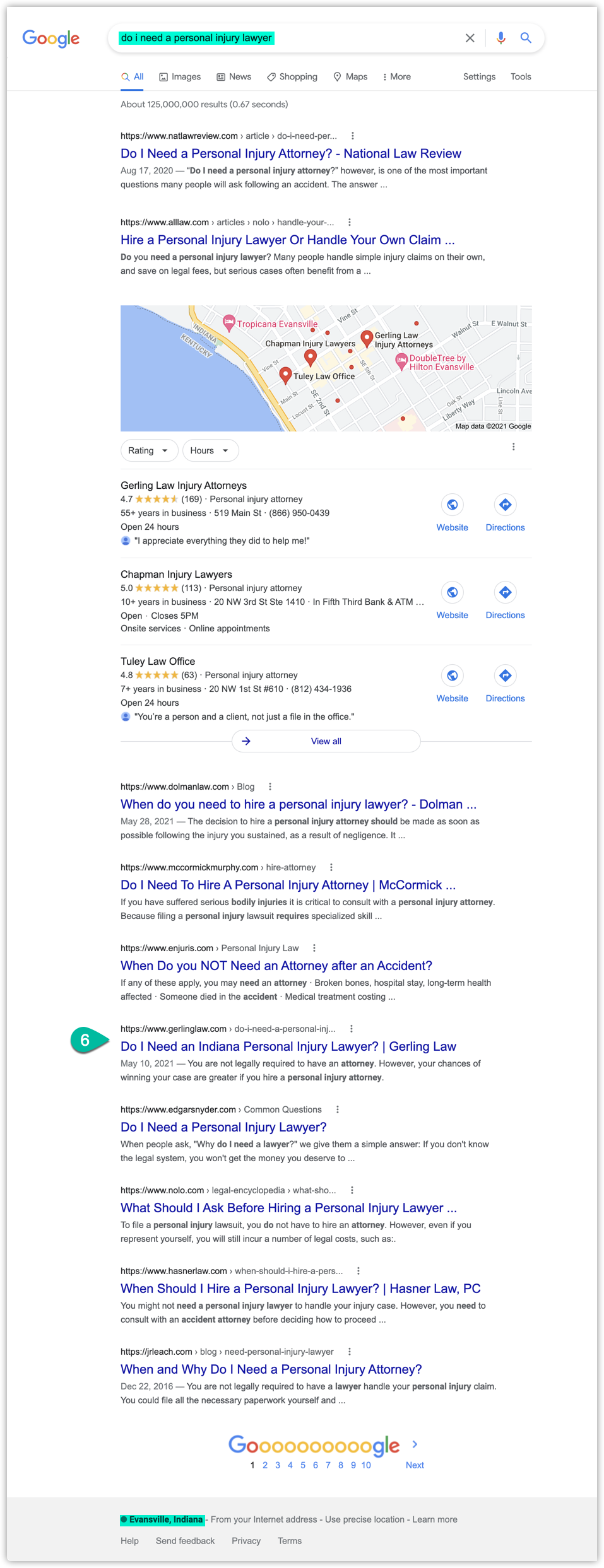
- Finally, when I checked the SERP today, I saw the post ranking #6 organic for our target keyword when searched from Evansville
A couple of things worth flagging in that sequence. The homepage ranking before the post is a pattern we see a lot. When a site picks up fresh local signals fast, Google tends to reach for the highest-authority URL on the domain first. It takes a few more days to figure out which specific page actually fits the query. The timing here lined up with that. A couple of days for the homepage to land. Around ten days for the post to hit #4. Several more days for the cached title tag to refresh. One last thing on the Google Search Console submission: it speeds up how fast Google finds the change, but not how fast Google re-ranks the page.
The Takeaways:
- Just because Google isn’t currently showing localized results for a keyword you want to target, doesn’t mean it won’t ever.
- Keep this in mind when doing keyword research. You may look at a keyword and be tempted to say “well, there aren’t any localized results and we can’t compete nationally, so let’s not do content on that topic”, but this test shows that that would be a mistake.
- Make localization of informational content a part of your re-optimization strategy.
- Make sure you are tracking your informational keyword rankings from your target geo-markets. Ie. If your firm is in Evansville Indiana, tracking your keywords from Los Angeles won’t show you an accurate picture of your visibility. The simplest setup is a rank tracker with city-level location settings, which most paid tools support out of the box. If you’re spot-checking SERPs manually, look for the location parameter in your tool of choice and set it to the city you actually care about. National-only data won’t surface what’s happening at the city level.
At Juris Digital, we’re an seo agency for attorneys that specializes in local SEO for law firms. If you want help executing tactics like the one in this post, check out our local law firm seo services.