Article updated on 1/28/26 to reflect the proposed pricing for OpenAI Ads.
OpenAI just changed the game. On January 16, 2026, they announced that ads are coming to ChatGPT within the next few weeks. For campaign planning and management, see our service for ChatGPT advertising for law firms.
For law firms that have been paying attention to AI or wondering when they can get more traffic from ChatGPT, this is one of the biggest developments in legal marketing since Google launched Local Service Ads.
Here’s what you need to know.
What OpenAI Announced
Fidji Simo, OpenAI’s CEO of Applications, published a blog post titled Our approach to advertising and expanding access to ChatGPT outlining the rollout. Sam Altman followed up with statements on X confirming the details.
What We Know So Far
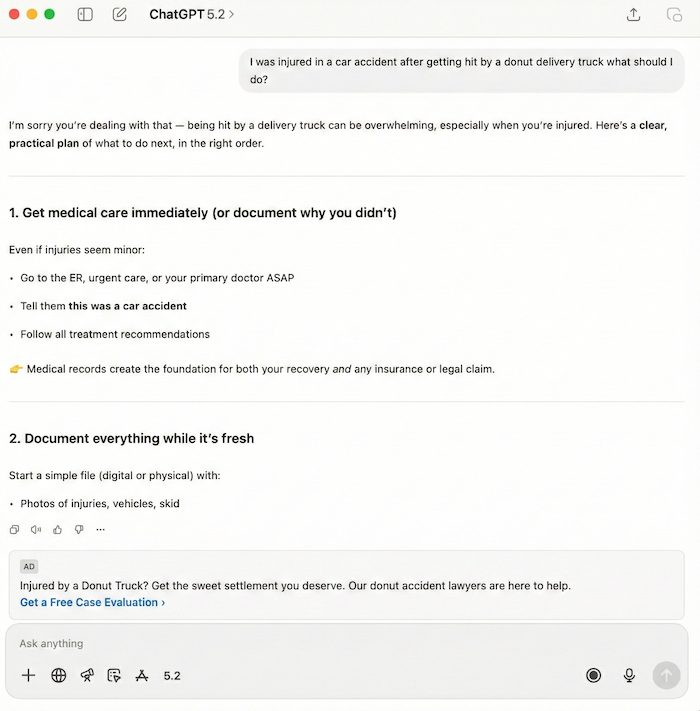
Ads will appear at the bottom of ChatGPT responses
– They’ll be clearly labeled as “Sponsored” (Like Google Does Now?)

– Targeting is based on what users are asking about in their conversations
– Testing starts in the US within weeks
This is conversation based advertising based on what the searcher is looking for. When someone asks ChatGPT about filing for divorce, dealing with a car accident, or starting a business, relevant ads may appear.
For law firms who want to get in front of people searching for answers in their situation, this could be significant.
Who Will See Ads (And Who Won’t)
Not everyone using ChatGPT will see advertisements. Take a look at the table below and you will see the tiers of subscribers who will see them.
| Tier | Monthly Cost | Ads? |
|---|---|---|
| Free | $0 | Yes |
| ChatGPT Go | $8 | Yes |
| ChatGPT Plus | $20 | No |
| ChatGPT Pro | $200 | No |
| Business/Enterprise | Varies | No |
This is especially relevant if your ideal customer type is going to be likely to using a paid tier vs. a free or cheap one.
Why This Matters for Law Firms
But at the end of the day, according to the most recent stats, ChatGPT has 800 million monthly users. Only about 5% pay for a subscription (including me). That means roughly 760 million people are using the free version and will soon see ads.
So Far, here’s what appears will make them different from Google Ads or Facebook.
Intent is crystal clear
When someone types “I was rear-ended yesterday, do I need a lawyer?” into ChatGPT, you know exactly what they need. There’s no guessing based on keywords or browsing behavior. The user is literally telling the AI their problem.
And some of the data we have collected internally shows that people are searching with more context and more words in these models.
For example, instead of “Car accident lawyer near me” they might type in “I was in a car accident on I-5 and rear ended. Now a few days later I’m getting back pain, could this have been from the accident? How can I tell?”
Conversion rates are reportedly higher
According to Axios , referrals from within ChatGPT conversations convert at 23x the rate of traditional search. The AI essentially pre-qualifies leads by walking users through their research process before showing an ad.
And this makes sense because even though the traffic isn’t huge in terms of website referrals, conversion rates for law firms have been higher. Spicy Take: Is this why keyword ranking and website traffic are not great KPI’s?
Competition will be low to start
Google’s legal keywords cost $50 to $200+ per click because every firm is fighting for the same space. ChatGPT ads are brand new.
Early movers have an advantage before the market gets saturated. Just like Google Authorship, Google Places, etc. etc. etc.
We’ve been tracking AI developments for years, but this is the first time I’ve seen a viable new advertising channel for law firms since LSAs launched. The intent signal here is unlike anything else. Someone asking ChatGPT about their legal situation is further down the decision funnel than someone Googling keywords.

How the Ads Actually Work
Based on OpenAI’s announcement and early reporting from TechCrunch here’s what we know about the format:
Placement: Ads appear at the bottom of ChatGPT’s response, separated by a visible line. They take up considerable screen real estate.
Labeling: All ads are marked “Sponsored” to distinguish them from the AI’s actual answer.
Interactive option: Some ads include a “Chat with Sponsor” feature. Users can click and ask follow-up questions directly to the advertiser’s bot. For a law firm, this could mean a potential client asking basic intake questions before ever picking up the phone.
Personalization: Ads are targeted based on the conversation. OpenAI says personalization is on by default, but users can opt out or clear their ad data. But lets be honest who is going to do this?
Restrictions: OpenAI confirmed ads won’t appear on certain sensitive topics including health, mental health, and politics.
Legal topics are notably NOT on the restricted list.
The Opportunity for Law Firms
Think about the types of questions people ask ChatGPT that have legal implications:
– “My landlord won’t return my security deposit. What can I do?”
– “I got a DUI last night. What happens next?”
– “How do I file for divorce in California?”
– “My employer fired me after I filed a workers comp claim. Is that legal?”
– “I want to start an LLC. What do I need?”
– “My father died without a will. How do we handle his estate?”
Every one of these is a potential client describing their exact legal need. And soon, you’ll be able to put your firm’s ad in front of them at that exact moment.
For personal injury attorneys, this is especially interesting. Someone describing an accident to ChatGPT is exhibiting higher intent than someone searching “car accident lawyer near me” on Google. They’re processing what happened and looking for guidance.
The same applies to family law marketing, criminal defense, estate planning, immigration, and virtually every practice area.
What We Don’t Know Yet
OpenAI hasn’t released full details on how advertisers will buy ads. Key unknowns include:
- What will the Pricing model be? Advertising on ChatGPT could cost triple what you’d pay on Facebook or Instagram. OpenAI is reportedly pricing ads at $60 per thousand impressions, according to The Information.
- Targeting options: Can you target by location, practice area keywords, or just broad categories?
- Self-service vs. managed: Will there be a dashboard like Google Ads, or will it require working with OpenAI directly?
- Ad creative requirements: Character limits, format restrictions, approval process?
- Reporting and attribution: How will we track leads and conversions?
We expect more details as the testing phase rolls out. Juris Digital is monitoring this closely and will be among the first to test the platform when it opens to advertisers.Stay Ahead of AI Legal Marketing Trends
Get weekly insights on how AI is transforming legal marketing, delivered straight to your inbox.
Because at the end of the day we only recommend advertising options where we can track your cost per case or build an attribution model that gets us there.
The Privacy Angle: What Lawyers Need to Consider
There’s a risk management side that every lawyer should think about.
For your clients: people are using ChatGPT to discuss legal matters. Some of those conversations may include sensitive or privileged information. That conversation data is now being analyzed for ad targeting.
OpenAI says they don’t share conversation content with advertisers and won’t sell user data. But you should also remember that “In 2024, Sam Altman publicly said he “hates” ads. He called the idea of combining advertising with AI “uniquely unsettling” and described it as a “last resort.”
What this means practically:
– Consider advising clients not to discuss case details on free-tier ChatGPT
– If your firm uses ChatGPT internally, use the Business or Enterprise tier (no ads, better privacy controls)
– Update your technology use policies to address AI chatbot usage
– Be aware that clients may mention conversations they’ve had with ChatGPT about their legal issues
A Stanford study published in late 2025 identified “several causes for concern, including long data retention periods, training on children’s data, and a general lack of transparency” in AI chatbot privacy practices. This isn’t unique to OpenAI, but it’s worth noting as ads add another layer of data usage.
How This Compares to Other Platforms
Google Ads / LSAs: Mature platform, high competition, expensive CPCs for legal. You’re bidding on keywords, not conversations. Google knows search intent but not the full context of what the user is dealing with.
Facebook/Meta: Good for brand awareness and retargeting, but intent is low. You’re interrupting people scrolling through their feed, not responding to someone actively seeking legal help.
ChatGPT Ads: Conversation-based intent. Users are describing their situation in detail. Higher relevance potential, but unproven platform with limited targeting options initially.
Claude (Anthropic): No ads. Enterprise-focused. If you’re recommending an AI assistant to clients who need privacy, Claude is currently the safer choice.
Google Gemini: Conflicting signals about 2026 ad plans. May follow OpenAI’s lead.
What Law Firms Should Do Now
1. Get on the list. OpenAI will likely open advertiser applications in the coming weeks. Make sure you’re positioned to test early. Or sign up for our newsletter an we will alert you.
2. Review your AI policies. If your firm uses ChatGPT, make sure you’re on an appropriate tier. Update staff guidelines about what can and can’t be discussed on AI platforms.
3. Prepare compliant ad creative. State bar advertising rules still apply. Start thinking about how you’ll communicate your firm’s value in a conversational ad format while meeting disclosure requirements.
4. Track the rollout. This is moving fast. The firms that pay attention and move quickly will have an advantage.
My prediction is that ChatGPT ads will become a meaningful channel for legal within 12 to 18 months. Not a replacement for Google, but a complement. The firms testing it now will have the data and experience to scale when it matures. The firms waiting will be playing catch-up in a more expensive market.
Juris Digital Is Testing ChatGPT Ads For Lawyers
We’re committed to being on the cutting edge of legal marketing and law firm seo. As soon as ChatGPT opens its ad platform to law firm advertisers, we’ll be running tests and sharing results with our clients.
If you want to be among the first law firms to try ChatGPT advertising, contact us. We’ll keep you updated on the rollout and let you know when it’s time to move.
The Bottom Line
ChatGPT ads represent a new frontier in legal marketing. The intent signal is strong. The competition is low. The platform is unproven but promising.
For law firms with the budget to experiment, this is worth watching closely. For everyone else, at minimum, understand what’s happening so you can make informed decisions about your marketing mix and your firm’s AI policies.
The legal industry has been slow to adapt to new marketing channels in the past. Google Ads, social media, LSAs. Each time, early adopters gained an edge. This could be the next one.
Sources
OpenAI: Our approach to advertising and expanding access to ChatGPT
CNBC: OpenAI to begin testing ads on ChatGPT in the U.S.
CNN Business: ChatGPT to start showing users ads based on their conversations
Axios: ChatGPT ads are coming, and they’ll be influenced by your conversations
TechCrunch: ChatGPT users are about to get hit with targeted ads
The Information: OpenAI Projections Imply Losses Tripling to $14 Billion in 2026
Bloomberg: OpenAI to Test Targeted Ads in ChatGPT
Stanford Report: Study exposes privacy risks of AI chatbot conversations
Last updated: