There’s a lot of noise right now around AI in legal.
Depending on which survey you read, adoption is either racing ahead or barely moving at all. Some headlines claim that nearly 80% of lawyers are using AI in some form. Others paint a much more conservative picture.
The reality? The percentage of law firms using AI is heavily disputed. But even when you look at conservative data, the implementation gap is hard to ignore.
According to Thomson Reuters’ 2025 Generative AI in Professional Services Report, based on a January–February 2025 survey of 1,702 professionals (42% located in the U.S., 41% in the legal industry), only 28% of law firm respondents say they are currently using generative AI tools. Even more telling: just 15% report that AI is currently a central part of their organization’s workflow.
That’s the real story.
Whether the headline number is 28% or 80%, full-scale law firm AI implementation remains rare. Individual attorneys may be experimenting with ChatGPT or piloting document review tools. But enterprise-wide integration? That’s where most firms stall.
The gap between experimentation and execution is driven by very real AI adoption challenges of law firms. These include unclear ROI, lack of training, cultural resistance, and the absence of a formal AI policy for law firms. Add to that the complexity of integrating generative AI in the legal industry while maintaining ethical practices, and it becomes clear why so many firms remain in “trial mode.”
TL;DR — Key Takeaways
- Assign clear ownership of AI. If no one owns the strategy, tools stay stuck in the experimentation phase and real law firm AI implementation never happens.
- Track ROI from day one. Measure outcomes like lead generation, intake conversion, and operational efficiency so AI investment is tied to business results.
- Start where the impact is visible. Marketing and intake often provide clearer ROI than research or drafting because improvements directly affect leads and signed cases.
- Bonus tip: Pick one area to pilot first—marketing or intake works well. Then, measure the results for 60–90 days and use that data to guide broader law firm AI implementation.
Common Reasons Why Law Firms Are Slow to Adopt
The data makes one thing clear: experimentation is happening, but full law firm AI implementation is not.
When you dig into why, the barriers are less about technology and more about structure, culture, and risk tolerance. Below are the most common friction points we see slowing firms down.
1. No Clear Ownership of AI Strategy
In many firms, AI lives in a gray area. No one in the organization typically knows if it’s a marketing experiment, an IT initiative, or something else entirely.
When no single leader or committee owns the strategy, law firm AI implementation drifts. Tools get tested in isolated pockets—litigation tries one platform, marketing experiments with another, a few associates use ChatGPT quietly—but no one is accountable for enterprise-wide rollout, governance, or performance measurement.
This lack of ownership often shows up in policy gaps. According to the same Reuters report mentioned above, only about 30% of organizations have AI-specific policies in place. That means the majority of firms are either operating under vague technology policies or have no formal guardrails at all.
Without clear leadership, there’s no clear answer to questions like:
- What tools are approved?
- What data can be entered?
- Who evaluates vendors?
- How is risk monitored?
- How is ROI measured?
When those questions remain unanswered, hesitation feels rational. But in practice, it slows meaningful law firm AI implementation because no one is empowered to move beyond the testing phase.
2. ROI Is Unclear (Or Not Measured at All)
One of the most underestimated AI adoption challenges of law firms isn’t technical. It’s financial.
According to the Reuters report, only 20% of respondents said their organizations are measuring ROI on AI tools. However, this includes all respondents, so the number of law firms actually measuring the ROI of generative AI is likely very low. That’s a massive blind spot.
In most industries, productivity gains are easy to quantify. If a process takes 10 hours and AI reduces it to 4, the savings are obvious.
In law firms, it’s more complicated.
If AI reduces research time, is that:
- A margin improvement?
- A billing reduction?
- A write-off?
- A competitive pricing advantage?
For firms that still rely heavily on hourly billing, generative AI in the legal industry introduces uncomfortable questions about rate structure, value perception, and client expectations. Without a clear financial model, partners hesitate to expand usage.
3. Firms Don’t Know Where AI Implementation Will Have the Most Impact
Even when leadership is open to AI, another question quickly follows:
Where do we actually start?
Generative AI in the legal industry touches almost everything—research, drafting, document review, intake, marketing, compliance, knowledge management, etc. When the surface area is that wide, prioritization becomes difficult. So firms either try to implement everywhere at once or nowhere at all. We can actually see this in a table provided by Reuters in their report.
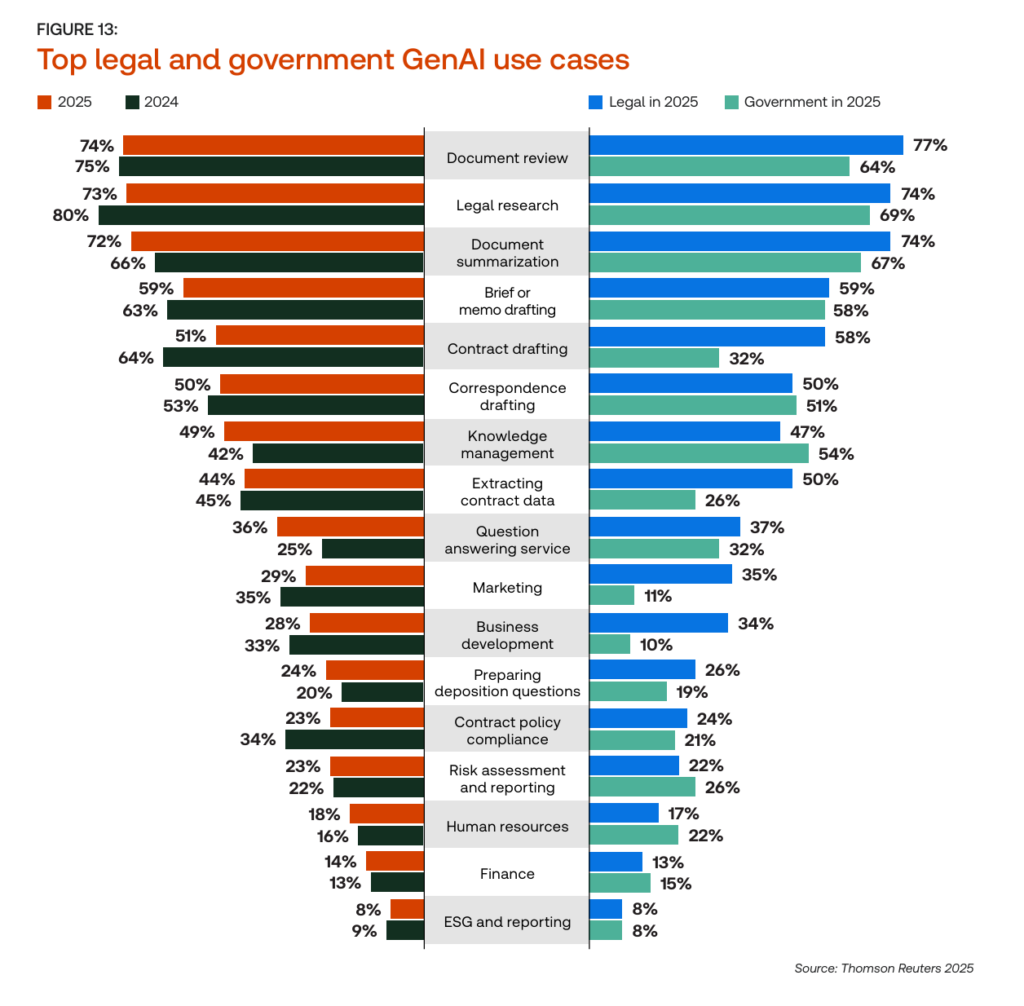
More than three-quarters of law firms already use AI for document review, and almost the same amount use it for legal research and document summarization. Maybe there is some argument to be made that this can increase ROI, but it really depends on the firm and its processes. What’s more intriguing is that middle area of the table.
Here, we see a lot of opportunities that firms are missing out on. Sure, about 50% of all the firms in this survey already use AI for gathering contact information (hopefully for leads). However, only a third use AI for marketing purposes and question answering. What’s ironic is that these areas are where firms have the potential to not only save a lot of money but also gain more leads.
Where AI Implementation Can Deliver Measurable Impact
One reason law firm AI implementation stalls is that firms tend to start in the most obvious places: document review, legal research, and drafting.
That makes sense. These are core legal workflows that are time-intensive. They feel ripe for automation. However, measuring their ROI is complicated.
When AI speeds up research or summarization, the impact is often absorbed into existing billing structures. On hourly matters, faster work can reduce billable time. On flat-fee matters, it may improve margin, but only if someone is tracking it. In many cases, the benefit is real but invisible.
That doesn’t mean firms shouldn’t use AI in those areas. It just means they shouldn’t stop there. If the goal of law firm AI implementation is measurable business impact, some of the clearest opportunities are outside traditional legal production.
Marketing
Marketing is one of the most practical and often overlooked areas for structured law firm AI implementation.
In our experience, law firms that come to us usually struggle on their own with consistency in content production. SEO initiatives stall because no one owns the cadence. However, generative AI in the legal industry can support:
- Outlining and drafting first versions of blog posts,
- Repurposing webinars into articles,
- Summarizing case updates into newsletters,
- Identifying long-tail query opportunities, and
- Analyzing performance data for content gaps.
The key difference? AI marketing outcomes are trackable. You can measure organic traffic growth, AI search visibility, lead volume, and most importantly, conversions.
If AI-assisted content generates five additional qualified leads per month and one signs, that revenue impact is clear. Unlike research efficiency, the connection between effort and outcome is tangible.
Intake
If marketing drives opportunity, intake determines whether that opportunity becomes revenue. However, intake is where many firms quietly lose money. Usually, that’s primarily due to slow response times and missed follow-ups with leads. Sometimes, it’s also because of inconsistent lead criteria and screening.
AI can help standardize and optimize this process by:
- Summarizing intake calls instantly,
- Scoring leads based on predefined criteria,
- Flagging high-value matters for immediate review,
- Automating follow-up communications, and
- Identifying patterns in rejected or lost leads.
Unlike drafting improvements, intake optimization has a clean business metric: signed cases. If conversion rates increase from 6% to 9%, it is measurable in revenue.
How Your Firm Can Move on from Experimentation
The legal industry has an execution problem when it comes to AI.
Interest is high. Experimentation is common. But structured, enterprise-wide law firm AI implementation is still rare. Firms are testing tools without aligning them to revenue, operations, or long-term strategy. Meanwhile, client expectations are shifting. Firms that operationalize AI, especially in marketing and intake, are quietly building structural advantages.
If you’re reading this and thinking, “Yes, we’re using AI… but I’m not sure it’s doing anything for us yet,” that’s a normal place to be. It just means you’re in the experimentation phase.
The next step is deciding whether you want to stay there.
If you want to talk through what thoughtful, measured law firm AI implementation could look like, let’s have that conversation.