Without content, there is no SEO. There is no PPC. There is no social media. There is no email. Without content, there is no marketing. So why is content priced like it’s the cherry on top rather than the whole sundae?
One of the core services we provide at Juris Digital is Legal content writing services. We employ a team of skilled writers – most of whom are attorneys – and we pay them fairly (well above industry norms).
We invest heavily in content writing because there is no marketing success without high quality content. Period.
Our content writing services are not cheap. We routinely lose out on content business because we don’t race to the bottom on price. (We also often win that business a few months later after time and money have been wasted on low-quality content).
If you are in the market for legal content, you are probably looking for both high quality and a reasonable price. So, how much should you pay for legal content?
Stop thinking about outputs and start thinking about outcomes.
Many content vendors charge based on their output. For example, 5 blog posts, 10 practice area pages, 3,500 words, etc. At Juris Digital we price our content writing – and indeed structure our entire content production system – based on outcomes not outputs. Here are some examples of the outcomes we strive for with each piece of content:
- High search rankings for relevant keywords in a reasonable time-frame
- Consistent, meaningful organic search traffic
- Traffic from relevant folks who may well become paying customers
- Enhanced user experience by way of providing accurate, actionable information
Would you spend $1,000 on a single page of content?
Sounds like a lot, eh? If you are thinking only about output, you would balk at spending that kind of money on a single page of website content.
But if you are thinking in terms of outcomes you would ask “what results can I expect a $1,000 page of content to produce?”
And then I might show you this:
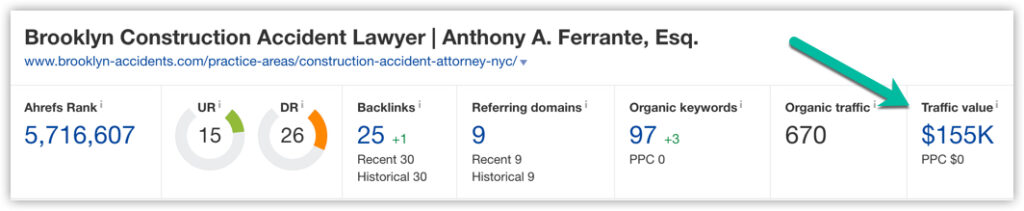
The value of the traffic generated by this single piece of content is $155k per month. That means, if you were to run PPC ads to target all of the keywords that bring in traffic for this page, you could expect to spend around $155k per month.
This client paid us $1,000, one time to create this piece of content. He said “I want more construction accident cases; how do I achieve that?”
We said “you need a best-in-class practice area page which is optimized for “construction accident lawyer” keywords in your city, Brooklyn”. We showed him projections of the type of traffic he could expect to generate if he ranked a single page of content for these keywords.
He didn’t hesitate to pay invest $1,000 because he knew he was investing in an outcome – getting more construction accident cases – not paying for outputs.
He paid invested $1,000 and the outcome is that he now gets lots of traffic from folks who have been injured in a construction site accident and need a lawyer.
For reference, in our experience most legal content vendors charge $150–$500 per practice area page. At that rate, you’re buying words. At $1,000, you’re buying research, strategy, and a published product optimized to rank. The difference shows up in your traffic reports.
Do you think he thinks he overpaid?
If you want to measure content ROI, watch three things: keyword rankings, organic traffic to the page, and leads you can trace back to that traffic. In our experience, firms see real movement on rankings within 3–6 months. Tying specific cases to specific pages usually takes closer to a year.
Our content writing process was created to generate positive outcomes
When you contact most legal content vendors, they will ask you what topics you want and how many words you want each to be.
This is ass-backwards.
Here’s our process:
Step 1: Get to the bottom of what you want to achieve
If you contact us about legal content (or SEO or PPC or website design or anything else we do), we will ask you what outcomes you hope to produce. You might say:
- I want more dog bite injury cases.
- I want to better educate my clients on their rights after an arrest.
- I want to become an authority on partnership disputes.
- I want to bring in clients from a broader geographic area.
Step 2: Use data to inform our content recommendations
Next, we’ll take what you tell us about your desired outcomes (goals) and we will do research in order to make data-informed recommendations for what sort of content will be required to achieve those goals.
One way this commonly plays out is that clients think they need 10 posts per month (indefinitely) to achieve a certain outcome. But our research might indicate that they actually only need to create a handful of posts for a specific topic cluster, each piece being optimized for specific clusters of keywords in order to reach their goals.
In competitive markets, expect 3–6 months before a new page builds enough authority to rank for its target terms. In our experience, that’s true whether you’re targeting a city or a practice area. The research we do upfront is what prevents you from spending those months waiting on content that was never going to rank.
In this way, our content process is built to generate positive outcomes, rather than to simply generate output. And while each individual piece of content might cost more with us, we will generally save you money in the long run by making sure that you don’t waste it on content that won’t produce any positive outcomes.
Step 3: Brief creation and handover to writers
Once we have a plan for what content needs to be created and what keywords will be targeted with each, our content managers will create a brief for our writers.
This brief will contain all of the information the writer needs to be successful, not just a title (which is what most content vendors provide to their writers).
Our briefs tell the writer what keywords to target, what the searcher actually needs to find, which competing pages to beat, and what internal links to include. Without that, even a great writer is guessing. Most cheap content vendors don’t provide one. That’s a big part of why their content doesn’t rank.
Step 4: Writing and editing
Next, the content is written by a writer who is best suited to the topic (ie. we have some writers who have practiced in certain areas of law, and so those folks are specifically chosen for topics within that area.)
We hire attorneys because they know what a statute actually says and they understand the advertising rules that govern what lawyers can and can’t say. More than that, they write in a way that earns a prospective client’s trust. A general freelancer can research the topic. They can’t replicate what it sounds like to have handled these cases.
Once the content is written, it is edited by one of our professional attorney-editors.
Writers don’t need to pass the bar to produce good legal content. What they need is real knowledge of how the law actually works and a feel for what injured folks or arrested folks are actually worried about. We hire attorneys because that combination is hard to fake and easy to spot when it’s missing.
Step 5: Publishing and submitting for indexation
Once the content is approved, we’ll publish it on your website. Since we are lawyer SEO pros, we’ll make sure that all crucial SEO elements are properly optimized based on the goals for each piece of content. Once the piece is published we’ll submit it to Google for indexation using Google Search Console.
So by investing in content with us, not only are you getting high quality words on page, you are getting a well formatted, well-optimized published final product that was polished off by an experienced search marketer.
What do you care about – output or outcomes?
If you only care about output – 20 blogs per month – then by all means, find the lowest price and go with God.
It’s worth naming what you’re actually risking. Cheap legal content often contains inaccurate legal information, which creates real exposure for your firm. AI-generated filler that reads like every other law firm site trains Google to treat your pages as thin. And low-quality content sometimes ranks briefly, then falls, leaving you with nothing to show for the spend.
But if you care about generating positive outcomes by investing in strategic, best-in-class content for your law firm, let’s talk.
Last updated: