We recently received an email from a client that stopped us in our tracks.
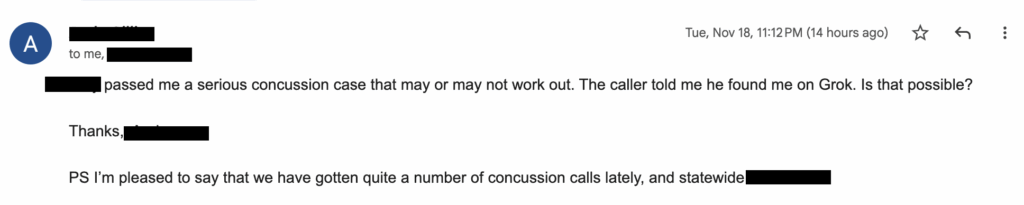
They had just gotten a high value concussion case lead that turned into a case shortly after the call. The caller didn’t find them through a Google Ad, a billboard, or a referral from a past client.
The caller explicitly said: “I found you on Grok.”
The client was shocked (“Is that possible?”), but for us, it confirmed a theory we’ve held for a long time.
Right now, the marketing world is obsessed with a new battle: SEO (Search Engine Optimization) vs. GEO (Generative Engine Optimization).
Marketers are scrambling, trying to figure out if they need to pivot their entire strategy to please AI chatbots instead of Google’s algorithm.
But this specific case study proves that the “battle” is a distraction. Here is the truth: It doesn’t matter what you call it.
The Human Need Hasn’t Changed
Whether it is 1995, 2015, or 2025, the human need remains exactly the same. When someone suffers a serious injury, they feel scared, confused, and overwhelmed. They go to the nearest available tool to find an expert they can trust.
- In 1990, that tool was the Yellow Pages.
- In 2010, that tool was a Google Search bar.
- In 2025, that tool might be a conversation with Grok or ChatGPT.
The medium changes, but the mission doesn’t. People are looking for answers, and they are looking for authority.
Do The Right Things, and It Works for Both
The client who got the referral from Grok didn’t pay us to do “Grok Optimization.” They paid us to build the most authoritative, helpful, and informative digital presence possible for their practice area.
Because we did “the right things” building deep content, establishing expertise, and answering real client questions the strategy worked on both platforms simultaneously.
- For Google (SEO): The search engine sees the depth of content and ranks the website high because it answers the user’s query effectively.
- For AI (GEO): The Large Language Model (Grok) scans the web for truth. It sees the same high-quality content, recognizes the firm as a verified entity, and cites them as the answer.
Authority is Universal
If you chase algorithms, you will be exhausted. If you chase authority, you will be future-proof.
The divide between SEO and GEO is artificial. Both systems want the same thing: to satisfy the user. Google wants to show the best link; Grok wants to speak the best answer.
If your law firm provides the best answer backed by experience, empathy, and clear communication you don’t have to choose a side.
Especially if you already focus on the added things LLM’s are looking for.
The Bottom Line
This concussion case is proof that you don’t need to reinvent the wheel to win in the age of AI.
Focus on being the most helpful, authoritative voice in your market. If you do that, it doesn’t matter if the potential client is using a phone book, a search engine, or a supercomputer they’re going to find you.