Not all legal searches behave the same. Criminal defense is one of the clearest examples of that.
If you compare how someone searches for a personal injury lawyer versus a criminal defense attorney, the difference is immediate. One is often research-driven. The other is urgent, emotional, and highly specific to a situation that feels personal and time-sensitive.
That distinction becomes even more pronounced in AI-powered search.
With the rise of tools like ChatGPT and Google’s AI Overviews, how people search for criminal lawyers using AI is shifting toward detailed, scenario-based questions. Instead of typing “criminal defense lawyer near me,” users are asking things like:
- “Will I go to jail for a first-time DUI in Texas?”
- “What should I do if I was arrested last night?”
- “Can charges be dropped before court?”
That’s why criminal defense SEO in AI environments behaves differently from other practice areas. The search itself is closer to the end of the funnel. There is less comparison, less exploration, and far less patience for generic content.
For firms thinking about criminal defense marketing strategy in 2026, this creates both a challenge and an opportunity. The challenge is that traditional SEO tactics don’t fully capture this behavior. The opportunity is that firms who understand it can show up at the exact moment a decision is being made.
TL;DR — Key Takeaways
- The firm that gets cited isn’t always the one that ranks highest. AI systems prioritize the clearest, most relevant answer, NOT the top organic position.
- Criminal defense searches are driven by urgency and situation. Try to answer full questions that someone might type into Google if they are in a similar situation to your regular clients.
- Content wins when it matches the exact question being asked. Pages that clearly explain charges, penalties, and next steps are far more likely to be pulled into AI-generated answers.
- Bonus tip: Search your top practice areas as full questions in Google. If your content doesn’t directly answer those questions, it’s unlikely to be cited in the AI overview, no matter how well it ranks.
What Makes Criminal Defense Queries Unique in AI Search
The easiest way to understand how AI overviews work for criminal defense is to see an example. In this case, let’s look at the following search:
What to do if you are accused of drunk driving in Denver
Notice how this search differs from something like a personal injury- or divorce-related question? That’s because this query is likely being typed in by somebody who needs an attorney now. They don’t have time to review many options and need the best help possible in the shortest amount of time. In other practice areas, keywords tend to represent top-of-funnel searches. So, what does the AI overview look like for this search?
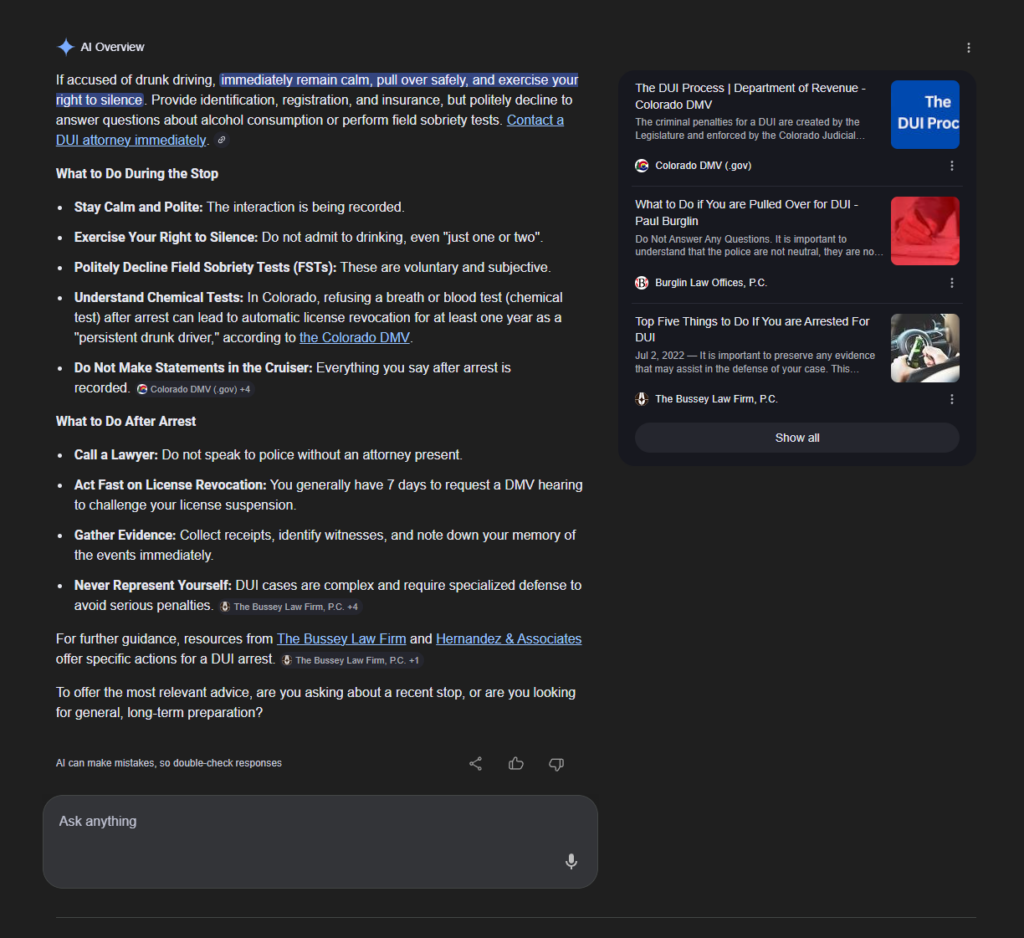
It turns out the AI overview steps in immediately and answers the question, providing a link to contact a law firm in the first section. It then lays out next steps, gives context, and pulls in a few other law firms to contact.
Then, take a look at this second screenshot. It is the same SERP, but notice that the firm linked first in the AI overview is only #4 in the organic results.

That is where things start to get interesting.
In a traditional search model, most firms are competing to be in the top three. That’s where the clicks used to go. But here, the firm getting the first real visibility isn’t in that group at all.
Related: From Search to Signed Case Without a Website Visit: The New Client Journey
So, What’s So Special About the First Page Listed in the AI Overview?
Since the first page listed by the AI overview isn’t in the top three organic results, your response might be: what gives? Don’t the top three pages have better SEO?
Well, yes and no.
The way Google ranks organic results in the SERP is not necessarily the same way that AI chooses citations. They are related, but they aren’t equivalent. Instead of looking at keywords, slugs, etc., the AI overview takes a holistic approach to reviewing pages. What they do more frequently is examine pages and sites for authority and trustworthiness. So, the more authority a page demonstrates and the more directly it answers the query, the more likely it is to be cited first, if at all.
In fact, this page is a good example of how criminal defense SEO with AI actually works in practice. It’s being chosen because it gives the AI something it can use. The content is well-structured. It doesn’t just describe the firm and breaks down the situation in a way that directly matches the query. For example, it:
- Explains what DUI charges are in Colorado;
- Outlines the different types of charges (DWAI, DUI, DUI per se);
- Clearly lists penalties like jail time, fines, and license suspension;
- Includes specific timelines (like the 10-day DMV hearing window); and
- Has sections listing previous results and featuring attorneys at the firm.
All of these factors combined are helpful for SEO in general, but they are essentially a requirement for being cited in AI overviews. From an AI perspective, this page checks a few important boxes.
It answers the question without needing extra interpretation.
The AI doesn’t have to piece together information from multiple sources. It can pull sections directly and build a response.
It’s location-specific.
The content is clearly tied to Colorado law and Denver context, which aligns with the query. Generic DUI pages don’t carry the same weight here.
It’s structured in a way that’s easy to extract.
The lists of charges and penalties make it easier for AI systems to identify and reuse key points inside an answer.
It provides concrete details, not general advice.
Things like BAC thresholds, sentencing ranges, and DMV deadlines are specific enough to be cited. That’s why this page shows up first in the AI Overview.
This is one of the core ideas behind criminal defense SEO with AI: the system selects usable passages. A page that clearly explains the situation will often beat a higher-ranking page that’s more general.
What This Means for Your Criminal Defense Strategy
If you zoom out, the takeaway here isn’t complicated, but it does require a shift in how you think about visibility.
Most firms are still building content around broad practice area pages and hoping those pages rank well enough to drive traffic. That approach still has value, but it doesn’t fully align with how these searches are actually happening.
The example in this post makes that pretty clear. The firm being cited didn’t “win” the search in the traditional sense. It showed up because it had content that directly addressed the situation the user described. That’s a different kind of optimization.
This is where criminal defense SEO with AI starts to become a practical strategy. It leads to pages that focus on:
- What happens after an arrest,
- What timelines matter,
- What penalties someone is realistically facing, and
- What steps they should take immediately.
In criminal defense, “early” matters more than in almost any other practice area. That’s why this is becoming a core part of criminal defense marketing strategy in 2026.
Show Up Where the Decision Starts
If you take anything from this, it should be this: criminal defense searches aren’t being won the same way they used to be.
People aren’t clicking through five websites and comparing firms anymore. They’re asking one question, getting one answer, and moving forward from there.
If your firm isn’t part of that first answer, whether it’s in an AI Overview or on another platform, you’re potentially missing out on a qualified lead.
The good news is that you don’t have to rebuild everything from scratch. Instead, you just need to tighten how your content aligns with real-world questions and make sure your authority shows up in more than one place.
If you’re curious how your firm is actually showing up in these searches, it’s worth taking a look. We can walk through a few of your core queries and give you a clear picture of what’s happening right now, and what would move you into that first layer of visibility.
Ready to Elevate Your Law Firm’s Marketing?
Let’s Talk